
Table of Contents
- Short Answer
- Biblical Context
- Bible Study Methods for Beginners
- Interpreting Difficult Bible Passages: A Practical Framework
- Using Historical Context in Bible Study
- How to Use a Catholic Bible Commentary
- Common Misunderstandings
- Practical Application for Today
- Conclusion and Encourage Further Bible Study
Last Updated: August 15, 2026
Short Answer
Understanding complex scripture requires patience, the right tools, and a willingness to slow down. Start by reading passages multiple times in different translations, identify who is speaking and to whom, explore the historical and cultural context, use cross-references to connect related passages, consult a Catholic Bible commentary, and pray for spiritual illumination. Most importantly, remember that the Bible is meant to be understood by ordinary believers seeking to know God’s word.
Biblical Context
The Bible wasn’t written in English, and it wasn’t written for our modern world. It’s a collection of texts spanning over a thousand years, written in Hebrew, Aramaic, and Greek, across vastly different cultures and historical settings. When we encounter difficult passages, we’re often running into gaps between their world and ours.
The Apostle Paul himself acknowledged that some of Scripture is hard to grasp. In 2 Peter 3:15-16, Peter writes about Paul’s letters: “There are some things in them hard to understand, which the ignorant and unstable twist to their own destruction, as they do the other scriptures” (NRSVCE). Peter’s point wasn’t that Scripture is impossible to understand, but that careless reading leads to distortion.
At BibleTopSearch.com, we believe you don’t need a theology degree to grasp what the Bible actually says. What you do need is a framework for approaching difficult passages with care. The good news is that this framework is learnable, and it transforms how you read Scripture.
Bible Study Methods for Beginners
The foundation of understanding complex scripture starts with how you approach the text itself. Many readers avoid difficult passages because they’ve internalized the belief that “real” Bible study requires hours of research, multiple languages, or seminary training. That’s false.
Start with the “one-sitting” rule. Read a passage once, slowly, in one sitting without consulting commentaries or cross-references. Just read. Write down one question or observation. This single step removes performance anxiety and lets you notice what naturally stands out. The Psalmist says, “I have more understanding than all my teachers, for your decrees are my meditation” (Psalm 119:99, NRSVCE).
Use the “two-translation” method. Read the passage in the NRSVCE, then read it in one other translation, the New American Bible Revised Edition, the Douay-Rheims, or the New Living Translation. Different word choices illuminate the same idea. A phrase that seemed opaque in one translation often clicks in another.
Identify the speaker and audience in one sentence. Ask: “Who is talking, and to whom?” Write your answer in one sentence. “Jesus is telling His disciples about the cost of following Him.” This one-sentence anchor prevents you from misapplying a passage meant for a different audience or situation.
Keep a three-column notebook. Draw three columns: (1) What does it say? (2) What questions do I have? (3) How might this apply to my life? Writing by hand slows you down enough to actually notice what you’re reading.
Use a study Bible strategically. A good study Bible includes cross-references, explanatory notes, and section headings. The Ignatius Catholic Study Bible and the Navarre Bible are designed for Catholic readers. Read the passage first, form your own thoughts, then check the notes. This makes notes a conversation partner rather than a replacement for your thinking.
Build a micro-habit, not a marathon. Commit to five minutes. Read a passage, write one observation, done. Five minutes is sustainable and compounds over time. After a month of five-minute sessions, you’ll have read and reflected on 20 passages.
These methods work because they remove friction and work with how your brain actually functions, through repetition, active engagement, and gradual understanding. The goal isn’t to become a Bible scholar. It’s to know God’s word well enough that it shapes how you think and live.
Interpreting Difficult Bible Passages: A Practical Framework
When you hit a passage that doesn’t make sense, here’s a step-by-step approach to interpreting difficult Bible passages.
The Contradiction Problem
You’ve probably noticed apparent contradictions. James says “faith without works is dead” (James 2:26, NRSVCE). Paul says we’re justified by faith, not by works (Romans 3:28, NRSVCE). Which is it? The answer isn’t that the Bible contradicts itself. It’s that you’re reading passages in isolation, without the larger context that reconciles them.
Step 1: Read the full context. Don’t stop at the verse that confused you. Read the entire chapter. When you read James 2:14-26 in full, you see James is addressing people who claim to have faith but show no evidence of it in their lives. He’s not saying works save you; he’s saying genuine faith produces works. When you read Romans 3:21-28 in full, Paul is addressing a different problem: people who think they can earn God’s favor through obedience to the law. Both are true. They’re addressing different problems.
Step 2: Identify the literary genre. The Bible contains history, poetry, prophecy, epistles, parables, and wisdom literature. A parable isn’t meant to be read like a historical account. Poetry uses metaphor differently than narrative. When the Psalmist says “My God, my God, why have you forsaken me?” (Psalm 22:1, NRSVCE), this is poetry expressing anguish, not a theological statement that God abandons people. Understanding the genre changes how you interpret what you’re reading.
Step 3: Look for the main point. Not every detail carries equal weight. When Jesus tells the parable of the prodigal son, the point isn’t that you should literally kill a fattened calf when your child returns home. The point is about God’s extravagant grace toward the repentant. Ask yourself: what is this passage trying to teach? What’s the core message?
Step 4: Check multiple translations. Sometimes a word in one translation opens up meaning obscured in another. The Greek word metanoia, translated as “repent,” means “to turn around” or “to change your mind.” Reading it in a translation that captures this meaning helps you see that repentance is about fundamental reorientation, not just emotion.
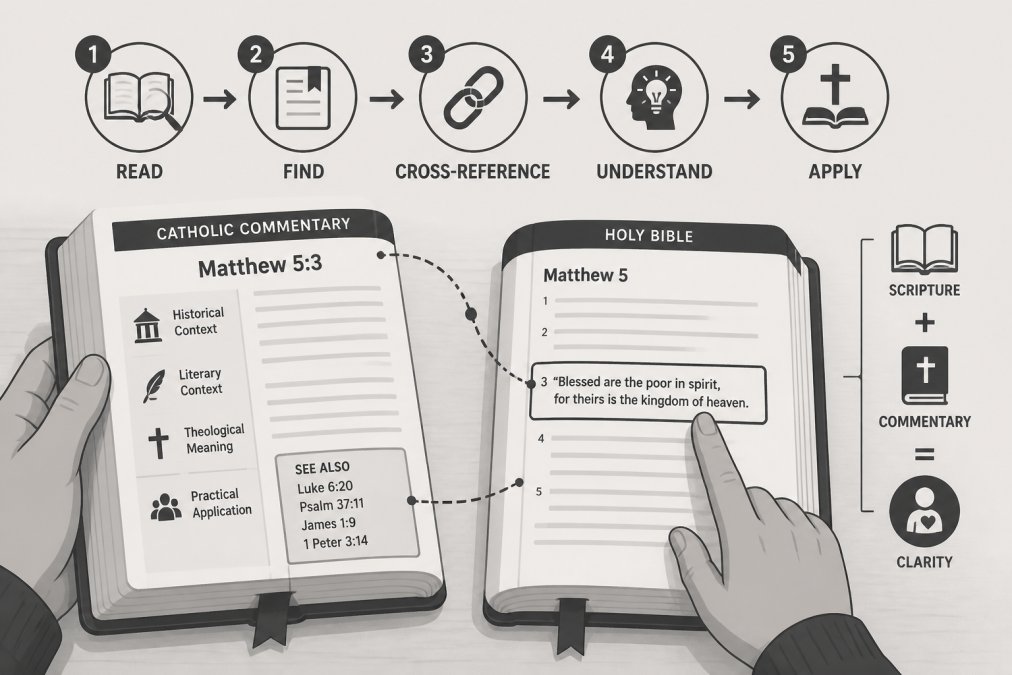
Step 5: Consult a Catholic commentary. A good commentary shows you how scholars have understood a passage, what historical context matters, and how seemingly contradictory passages fit together. The Navarre Bible, the Catholic Commentary on Sacred Scripture, and the Ignatius Catholic Study Bible all address these tensions and show how they’re reconciled within the broader biblical narrative.
The “Apparent Contradiction” Checklist
When two passages seem to contradict, work through this checklist:
- Are they addressing the same question? Often they’re not. James asks, “Does faith without works save you?” Paul asks, “Does obedience to the law save you?” Different questions mean different answers.
- Are they written to the same audience? Paul writes to Gentile churches struggling with Jewish law. James writes to Jewish Christians. Context matters.
- Are they using words the same way? “Faith” sometimes means intellectual assent, sometimes means trust. “Works” in James means evidence of faith; “works” in Paul means trying to earn salvation through the law.
- Is one passage addressing a misuse of the other? Often, later Scripture corrects a misunderstanding of earlier Scripture.
- Can both be true at the same time? Usually, yes. God is sovereign and humans have real choices. Salvation is a free gift and requires our response. Scripture often holds these tensions together.
When you work through this checklist, most “contradictions” dissolve. You’re discovering that Scripture is more nuanced and wise than a surface reading suggests.
Using Historical Context in Bible Study
One of the most common reasons passages confuse us is that we’re reading ancient documents without understanding their world. Historical context in Bible study is essential to avoiding serious misinterpretation.
When Paul tells women to remain silent in churches (1 Corinthians 14:34-35), this seems to contradict his affirmation of women prophesying in 1 Corinthians 11. Understanding the historical situation in Corinth, where specific disruptions were happening, helps you see Paul isn’t making a blanket statement about women’s voices. He’s addressing a particular problem in that congregation.
Enjoyed this article? Download your FREE guide: Ten Difficult Bible Questions Answered→
When Jesus tells His disciples not to carry a purse or bag (Luke 10:4), He’s not saying Christians should never plan or prepare. He’s telling them to trust God’s provision for a specific mission. The context is crucial.
Understanding cultural practices matters too. When someone “sat at the feet” of a rabbi, they were becoming a disciple. When a woman anointed Jesus’ feet with perfume, this was a shocking act of humility and devotion. When Jesus washed His disciples’ feet, He was doing the work of a servant, an act that would have been culturally scandalous for a rabbi.
The epistles weren’t written as systematic theology; they were written to specific churches dealing with specific problems. Romans addresses Jewish-Gentile tensions. Galatians addresses a crisis about circumcision and the law. Corinthians addresses divisions, sexual immorality, and confusion about spiritual gifts. When you understand the problem being addressed, the solution makes sense.
How to Use a Catholic Bible Commentary
A Catholic Bible commentary is one of your most valuable tools for understanding complex scripture. Knowing how to use one well makes all the difference.
Choose a reliable commentary. Look for commentaries written by Catholic scholars who take Scripture seriously and respect the Church’s teaching tradition. The Navarre Bible series, the Catholic Commentary on Sacred Scripture, and the Ignatius Catholic Study Bible are all excellent resources written specifically for Catholic readers. They explain the text, provide historical context, and show how passages connect to Church teaching and the broader biblical narrative.
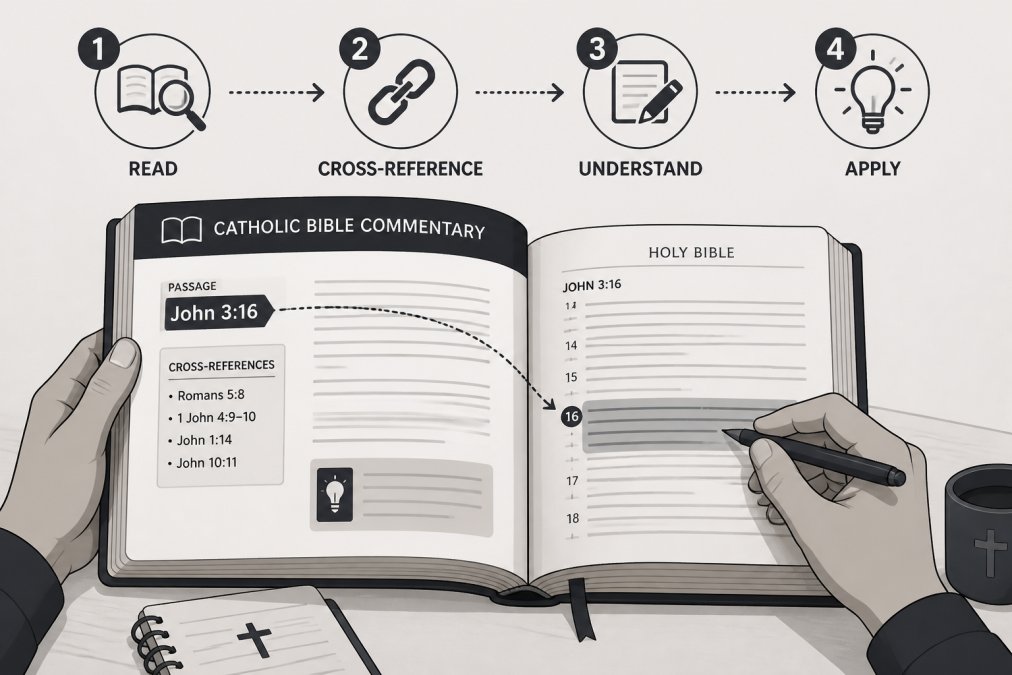
Use it as a conversation partner, not a replacement. Read the passage yourself first. Form your own thoughts. Then consult the commentary to see what scholars have noticed that you might have missed.
Look for the commentary’s approach to the passage. Does it explain the historical background? Does it note textual variants or translation choices? Does it show how this passage fits into the larger biblical narrative? A good commentary does all of these things.
Pay attention to cross-references. Commentaries are full of references to other passages. When a commentary shows you that a phrase in Matthew echoes Isaiah, or that Paul’s argument in Romans builds on ideas from the Psalms, you’re seeing how Scripture interprets Scripture.
Don’t skip the introductions. Most commentaries include an introduction to each book explaining who wrote it, when, to whom, and why. These introductions provide the context that makes everything else click into place.
Common Misunderstandings
When people struggle with understanding complex scripture, certain misunderstandings tend to surface.
Misunderstanding 1: “If I don’t understand it immediately, I’m not spiritual enough.” This is false. Even mature Christians encounter passages that require study, prayer, and consultation with others. The Psalmist says, “Your word is a lamp to my feet and a light to my path” (Psalm 119:105, NRSVCE). A lamp illuminates the next step, not the entire journey.
Misunderstanding 2: “All Bible passages mean whatever they mean to me personally.” This confuses personal application with interpretation. A passage has an original meaning, what the author intended to communicate to the original audience. Your personal application should flow from that meaning, not replace it.
Misunderstanding 3: “Difficult passages are probably errors or corruptions in the text.” Some passages are genuinely hard, but that doesn’t mean they’re wrong. The difficulty often points to something important. When you sit with a hard passage long enough to understand it, you usually discover profound truth.
Misunderstanding 4: “I need to understand everything before I can trust Scripture.” You don’t. You can trust what you do understand and remain open to growing in understanding about what you don’t. Faith and understanding develop together over time.
Misunderstanding 5: “Historical and cultural context contradicts the authority of Scripture.” It doesn’t. Understanding that Paul wrote to a specific church about a specific problem doesn’t make his words less authoritative; it makes them more intelligible.
Practical Application for Today
Understanding Scripture isn’t just an intellectual exercise. It’s meant to transform how you live.
Start with a passage that matters to you personally. Maybe you’re struggling with anxiety and want to understand what Scripture says about worry and trust. Maybe you’re navigating a relationship question and want to see what the Bible teaches about love and commitment. Choose a passage that connects to your actual life.
Apply the methods we’ve discussed. Read it multiple times. Identify the speaker and audience. Look at the context. Consult a commentary. Pray as you study, asking the Holy Spirit to illuminate the text and show you how it applies to your situation.
Then ask: What is God saying to me through this passage? You’ve done the work of understanding what the passage meant to its original audience. Now you ask how that meaning addresses your life today. The principle might look different in your context, but it flows from the same truth.
Keep returning to passages you’ve studied. Scripture reveals new layers as you grow spiritually. A passage you understood one way five years ago might speak to you differently now. This isn’t contradiction; it’s the living nature of God’s word meeting you where you are.
Conclusion and Encourage Further Bible Study
Understanding complex scripture is possible for anyone willing to slow down and use the right tools. You don’t need a theology degree. You need patience, a willingness to read carefully, access to good resources like a Catholic Bible commentary, and a prayerful spirit open to what God wants to teach you.
The Bible was written to be understood. Jesus taught in parables and direct instruction. The Apostles explained Scripture to new believers. The Church has always believed that ordinary Christians can grasp God’s word when they approach it thoughtfully and humbly.
At BibleTopSearch.com, we’re committed to helping you understand Scripture more deeply. We’ve created resources specifically designed for people like you, people who want clarity without complexity, biblical faithfulness without academic jargon, and practical wisdom for daily life.
Explore more Bible teaching through our free guides and video resources. Watch our in-depth teachings on YouTube where we walk through difficult passages together. Download our free Bible study guide to deepen your understanding of topics you care about. Return to BibleTopSearch.com whenever you encounter a passage that puzzles you, we’re here to help you discover what Scripture truly says.
The invitation of Scripture is clear: “Come, let us reason together” (Isaiah 1:18, NRSVCE). God invites you into understanding His word. Take that invitation seriously, use the tools available to you, and watch how your relationship with Scripture, and with God, transforms.
| Method | What It Does | When to Use |
|---|---|---|
| Read multiple times | Reveals new details with each reading | Starting with any passage |
| Identify speaker and audience | Shows who is talking to whom and why | Understanding context |
| Check different translations | Clarifies meaning through translation choices | When a phrase confuses you |
| Study the literary genre | Helps you interpret poetry, parable, history differently | Before interpreting the passage |
| Use cross-references | Connects related passages across Scripture | Building understanding |
| Consult a Catholic commentary | Provides scholarly insight and historical background | After your own initial study |
| Pray for illumination | Invites the Holy Spirit into your study | Throughout the entire process |
Frequently Asked Questions
What are the most difficult Bible verses to understand?
Some of the most challenging passages include apocalyptic texts like Revelation, prophetic books like Daniel, and passages involving symbolic or poetic language. Parables can also confuse readers because they teach spiritual truths through earthly stories. The key to understanding complex scripture is recognizing the literary genre, identifying the original audience, and reading surrounding verses for context. Don’t rush—many difficult passages become clearer as you deepen your overall Bible knowledge and spiritual maturity.
How can I use context to interpret confusing passages?
Context is essential for understanding complex scripture. Always read the verses before and after a confusing passage, check who is speaking and to whom, and look at the chapter and book structure. Historical and cultural background matters too—what made sense to the original audience may require explanation today. Use cross-references to see how other parts of Scripture address the same topic. Prayer and patience are vital; ask the Holy Spirit for illumination and don’t force an interpretation that contradicts the broader biblical message.
What tools can help me understand historical and cultural backgrounds of the Bible?
Catholic Bible commentaries like the Ignatius Catholic Study Bible or the New American Bible Revised Edition (NABRE) provide historical notes and cultural context. Bible dictionaries and Bible atlases explain customs, geography, and historical events. Many study Bibles include introductions to each book with background information. Free online resources and Bible study apps can supplement these tools. The Catechism of the Catholic Church also helps interpret Scripture within the tradition of the Church, ensuring your understanding aligns with authentic Catholic teaching.
Why is it important to read Scripture within the tradition of the Church?
Scripture doesn’t exist in isolation—it was written within a faith community and is best understood in that context. The Catholic tradition, guided by the Magisterium and the teachings of the Church Fathers, provides wisdom accumulated over two thousand years of faithful study and prayer. This prevents personal interpretation from drifting into error and connects you to the communion of saints who have wrestled with these texts before you. Reading Scripture with the Church ensures your understanding remains grounded in apostolic faith and helps you avoid misinterpretations that contradict core Christian doctrine.