Table of Contents
- Short Answer: What the Bible Says About Overcoming Spiritual Doubt
- Biblical Context: Understanding Doubt in Scripture
- Biblical Examples of Doubt and Faith
- Identifying the Root Causes of Your Doubt
- The Role of Prayer in Overcoming Spiritual Doubt
- Prayers for When You Doubt God
- How to Strengthen Faith When Struggling
- Common Misunderstandings About Doubt and Faith
- Practical Steps for Your Faith Journey Today
- Conclusion: Your Path Forward
Last Updated: August 16, 2026
Short Answer: What the Bible Says About Overcoming Spiritual Doubt
Overcoming spiritual doubt begins with honesty about your struggle and a willingness to bring your questions to God. The Bible doesn’t condemn doubt; it shows us that faith and doubt often coexist, and wrestling with God can deepen your trust in Him. Prayer, Scripture study, community support, and honest reflection on the roots of your doubt are the biblical pathways forward. Doubt doesn’t disqualify you from faith, it can become a catalyst for genuine spiritual maturity.
Biblical Context: Understanding Doubt in Scripture
Doubt appears throughout Scripture not as a sin to be ashamed of, but as a human response to mystery and uncertainty. The Bible shows us faithful people wrestling with God’s silence, His timing, and His ways.
When we look at biblical figures, we see a pattern: doubt often precedes deeper conviction. Abraham questioned how God could fulfill His promise when Sarah was barren. Moses asked God who He was before accepting his calling. Even John the Baptist sent messengers asking Jesus if He was truly the one to come. These weren’t failures of faith; they were moments where believers brought their real questions to God.
Scripture distinguishes between doubt that drives you toward God and doubt that pushes you away. Doubt that leads to questions, prayer, and seeking is part of spiritual formation. The apostle Paul writes that we “walk by faith, not by sight” (2 Corinthians 5:7). This acknowledges that faith exists precisely because we cannot see everything clearly. Uncertainty is the condition all believers live in until we see God face to face.
Biblical Examples of Doubt and Faith
Thomas, often called “the doubter,” refused to believe the resurrection until he saw Jesus himself. Yet Jesus didn’t condemn him. Instead, Jesus appeared to Thomas and invited him to touch His wounds. Thomas’s doubt led him to the deepest confession of faith in the Gospel: “My Lord and my God!” (John 20:28). His skepticism was transformed into unwavering conviction.
Peter walked on water toward Jesus, then fear overtook him and he began to sink. “Why did you doubt?” Jesus asked (Matthew 14:31). But Jesus didn’t reject Peter for his doubt. He caught him and continued building him into the rock upon which the Church would be built.
Job’s entire book is structured around his struggle with doubt. He questions God about suffering and demands answers. God’s response isn’t to punish Job for his honesty, but to engage with him and reveal dimensions of His character. By the end, Job’s doubt has transformed into deeper reverence: “I had heard of you by the hearing of the ear, but now my eye sees you” (Job 42:5).
Even Jesus, in His humanity, experienced a moment that looked like doubt. On the cross, He cried out, “My God, my God, why have you forsaken me?” (Matthew 27:46). This wasn’t lack of faith; it was the deepest expression of trust, quoting Psalm 22, which moves from lament to confidence in God’s deliverance.
Identifying the Root Causes of Your Doubt
Understanding where your doubt originates is essential to addressing it.
Intellectual doubt arises when your questions about Scripture, theology, or God’s nature go unanswered. You might struggle with how to reconcile different biblical passages or understand suffering in a world created by a loving God. This kind of doubt often comes from taking your faith seriously enough to think deeply about it.
Emotional doubt emerges from pain, loss, or unmet expectations. When prayers seem unanswered or tragedy strikes, emotional doubt can overwhelm you. You might feel abandoned by God or angry at Him for allowing suffering.
Circumstantial doubt comes from living in a secular culture surrounded by voices that question faith and mock belief in God. The constant exposure to skepticism can erode your confidence in your own convictions.
Doubt born from spiritual discipline can arise as you grow in faith and read Scripture more carefully. You notice things that trouble you or interpretations that now seem oversimplified. This is actually a sign of spiritual maturity, not decline.
The first step toward overcoming your doubt is naming which kind you’re experiencing. Recognizing the root helps you address it with the appropriate response.
The Role of Prayer in Overcoming Spiritual Doubt
Prayer is not something you do after you’ve resolved your doubts; it’s the primary tool for working through them. The Bible invites us to bring our doubts directly to God, not to hide them or pretend they don’t exist.
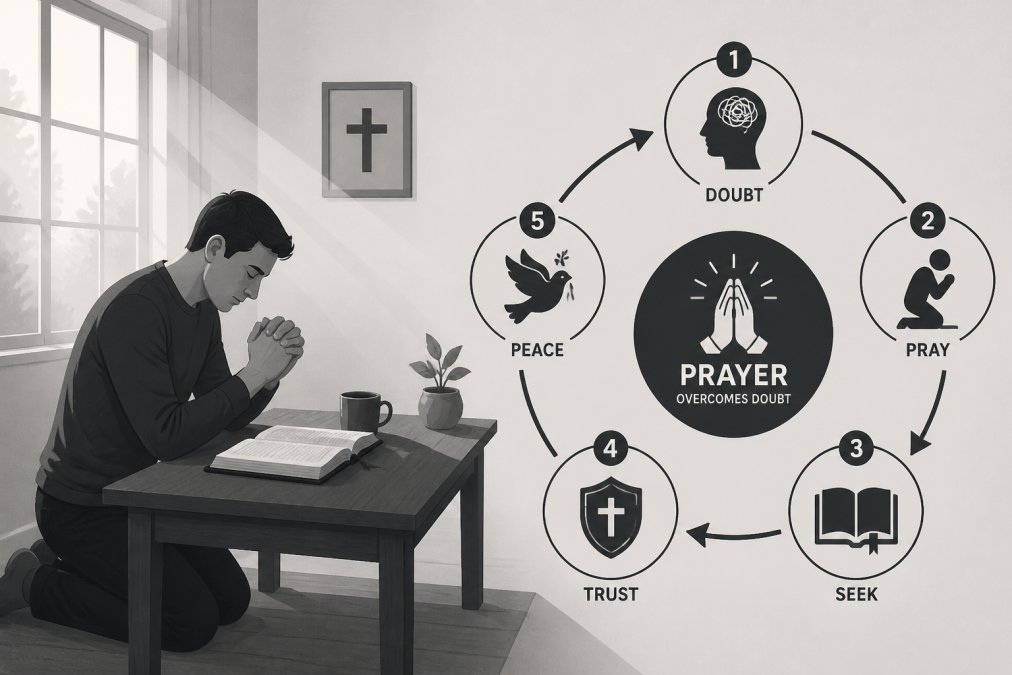
When you pray about your doubt, you’re not being irreverent or faithless. You’re following the pattern established throughout Scripture. The Psalms are filled with prayers of lament and honest questioning. Psalm 13 opens with “How long, O Lord? Will you forget me forever?” (Psalm 13:1). The psalmist doesn’t pretend everything is fine. He brings his real struggle to God. By the final verse, the psalmist has moved from despair to trust, not because his circumstances changed, but because he brought his struggle into God’s presence.
Prayer about doubt works on multiple levels. First, it acknowledges that God is big enough to handle your questions. Second, prayer shifts your perspective from isolation into relationship. Third, prayer opens you to God’s Spirit working in your heart. God meets you in your honesty.
Prayers for When You Doubt God
Here are prayers you can adapt when doubt is overwhelming:
A Prayer When God Feels Distant: “God, I’m struggling. I don’t feel Your presence the way I want to. Help me remember that my feelings don’t determine Your reality. You are here even when I can’t sense You. Give me faith that holds on because I choose to trust You.”
A Prayer When Circumstances Don’t Make Sense: “Lord, I don’t understand why this is happening. Help me trust that You see what I cannot see, and that Your wisdom is deeper than my confusion.”
A Prayer When Surrounded by Skepticism: “God, I hear voices telling me that faith is foolish. Strengthen my faith and give me courage to stand firm even when it costs me socially.”
A Prayer for Intellectual Questions: “God, I have real questions about Scripture and theology. Help me pursue truth with humility and distinguish between questions that deepen my faith and doubts designed to undermine it.”
A Prayer for Trust When You’re Tired: “Lord, I’m exhausted from the struggle. Help me rest in You even though I don’t have all the answers. Remind me that faith is about trust, not perfect certainty.”
How to Strengthen Faith When Struggling
Beyond prayer, Scripture offers us practical pathways to strengthen faith when doubt threatens to overwhelm it.
Study Scripture intentionally. Don’t avoid the difficult passages. Engage with them carefully, read them in context, and explore what biblical scholars and faithful commentators have written about them. The Bible is strong enough to handle your questions. Wrestling with Scripture is one of the most powerful ways to deepen your understanding of God.
Seek community and mentorship. Doubt thrives in isolation. When you bring your doubts into conversation with other believers, especially mature believers who have walked through seasons of doubt themselves, something shifts. You realize you’re not alone. Consider finding a spiritual director, a trusted pastor, or a small group where you can be honest about your faith journey.
Practice spiritual discipline. Disciplines like prayer, Bible study, worship, and service aren’t ways to earn God’s favor. They’re practices that orient your heart and mind toward God. When doubt clouds your thinking, these disciplines help you remember what you believe even when you don’t feel it.
Reflect on your spiritual history. Take time to remember moments when God has been faithful to you. You’ve experienced God’s presence, His guidance, His provision. Those experiences are real. When doubt tempts you to believe that God has never shown up for you, your spiritual history reminds you otherwise.
Engage with apologetics thoughtfully. Resources that explore how Christians think about science, suffering, and the reliability of Scripture can provide frameworks for your thinking. However, apologetics alone won’t resolve doubt rooted in emotion or experience. They’re one tool among many.
Common Misunderstandings About Doubt and Faith
Several misconceptions about doubt can actually deepen your struggle.
Misunderstanding #1: Doubt means you don’t really believe. The assumption is that real faith means certainty, and any wavering means your faith is false. But faith and doubt can coexist. The father in Mark 9 who brings his demon-possessed son to Jesus says something remarkable: “I believe; help my unbelief!” (Mark 9:24). He’s admitting that belief and unbelief are both present in him. Jesus honors that honesty.
Misunderstanding #2: Doubt is always a sin. The Bible distinguishes between doubt that seeks understanding and doubt that refuses to trust. Asking God questions isn’t sin. What the Bible warns against is hardening your heart against God or allowing doubt to lead you into disobedience.
Misunderstanding #3: Mature Christians don’t doubt. Some of the most spiritually mature people have deep questions about faith. Doubt isn’t a sign of spiritual immaturity; it can be a sign of spiritual seriousness.
Misunderstanding #4: You need to resolve all your doubts before you can move forward in faith. You will never have perfect clarity about everything. You can move forward in trust even while holding your questions. That’s what faith is.
Misunderstanding #5: If you doubt, you’re not a “real Christian.” The New Testament describes the Christian life as a journey of growing in faith and understanding. Doubt is part of that journey for many people. It doesn’t disqualify you from being a genuine follower of Jesus.
Practical Steps for Your Faith Journey Today
Moving from doubt toward stronger faith requires concrete action.

Step 1: Name your specific doubt. Write down exactly what you’re struggling with. The more specific you can be, the more effectively you can address it.
Step 2: Bring it to God in prayer. Tell God what you’re struggling with. This isn’t about having the right words; it’s about honesty.
Step 3: Study Scripture related to your doubt. If you’re doubting God’s faithfulness, read passages about God’s faithfulness. Let Scripture speak to your doubt.
Step 4: Find someone to talk to. Share your doubt with a pastor, spiritual director, or trusted Christian friend who won’t dismiss it or judge you.
Step 5: Give it time. Doubt doesn’t always resolve quickly. Continue praying, studying, and seeking community. Trust that God is working even when you can’t see immediate resolution.
Step 6: Look for evidence of God’s faithfulness in your life. Notice the ways God has shown up for you. These aren’t coincidences; they’re evidence of God’s active presence.
Step 7: Consider how your doubt might be inviting you to deeper faith. Your questions might be pushing you toward a more authentic, harder-won faith. That’s spiritual formation.
Conclusion: Your Path Forward
Overcoming spiritual doubt isn’t about reaching a place where you never question anything again. It’s about learning to live with your questions while maintaining trust in God. The Bible shows us that doubt and faith aren’t opposites; they’re often companions on the journey toward deeper conviction.
Your doubt doesn’t disqualify you from faith. It makes you honest. When you stop pretending to have certainty you don’t have and start bringing your real self to God, questions, confusion, and all, that’s when transformation happens.
The path forward involves prayer, Scripture study, community, reflection, and time. Remember: Thomas doubted and became a powerful witness to the resurrection. Peter doubted and became the rock of the Church. Job doubted and encountered God in a deeper way. Your doubt, brought honestly to God, can become the pathway to genuine faith.
Encourage Further Bible Study
As you continue your faith journey, we encourage you to explore these passages on your own:
- John 20:24-29, Thomas’s doubt and Jesus’s response
- Matthew 14:28-31, Peter walking on water and his doubt
- Job 42:1-6, Job’s transformation through wrestling with God
- Psalm 13, A prayer that moves from doubt to trust
- 2 Corinthians 5:7, Walking by faith, not by sight
- Mark 9:24, “I believe; help my unbelief!”
At BibleTopSearch.com, we understand that faith questions are part of the spiritual journey. We’ve created resources specifically designed to help you find clarity and confidence in what the Bible actually says. Our free Bible guides break down commonly searched spiritual questions into simple, Scripture-based answers you can return to anytime.
We invite you to explore more articles on faith, doubt, prayer, and spiritual growth on BibleTopSearch.com. Watch our corresponding YouTube video on this topic to hear more about how to overcome spiritual doubt through Scripture and community. Download our free Bible guide for deeper study on faith and doubt, and continue exploring Bible Answers as you grow in your relationship with Christ.
Your questions matter. Your struggle matters. And God meets you in both.
Frequently Asked Questions
Is it a sin to have doubts about God?
No. Doubt is not inherently sinful. Many biblical figures—including Abraham, Moses, and even John the Baptist—experienced seasons of doubt while maintaining their faith. What matters is how you respond. Bringing your questions to God in prayer, seeking understanding through Scripture, and remaining open to His guidance transforms doubt into an opportunity for spiritual growth and deeper conviction.
Who in the Bible struggled with doubt?
Thomas, often called 'doubting Thomas,' asked for proof of Jesus's resurrection. Abraham questioned how God could fulfill His promise of descendants. Moses doubted his ability to lead Israel. Job wrestled with suffering and God's silence. These biblical examples of doubt show that questioning is part of the human experience, not a mark of weak faith. Each figure ultimately grew closer to God through their struggle.
How do I start praying when I'm struggling with doubt?
Begin with honesty. Tell God exactly what you're feeling—confusion, fear, anger, or uncertainty. You don't need perfect words. Jesus taught us to bring our whole selves to prayer. Use simple phrases: 'God, I'm struggling to trust right now' or 'Help me understand.' Prayers for when you doubt God don't require eloquence; they require authenticity. Read Psalms for examples of raw, honest prayers that wrestle with doubt.
What's the fastest way to strengthen my faith during a crisis?
Three things work together: Read Scripture directly (not just commentary), spend time in prayer expressing your real feelings, and connect with a faith community. How to strengthen faith when struggling isn't about speed—it's about consistency and honesty. Even 10 minutes daily of Bible reading and prayer creates spiritual momentum. Seek mentorship from a trusted pastor or spiritual director who can walk with you through this season.