
Table of Contents
- Short Answer: Faith Doesn’t Require Perfection
- Biblical Context: God’s Heart for Busy Hearts
- How to Read the Bible in 5 Minutes a Day
- How to Pray When You Are Overwhelmed
- Short Daily Devotions for Busy Professionals
- Micro-Habits: Faith Under 60 Seconds
- Integrating Faith Into Your Daily Routine
- Overcoming the ‘Too Busy’ Mindset
- Practical Application for Today
- Conclusion: Your Spiritual Connection Matters
Last Updated: August 17, 2026
Short Answer: Faith Doesn’t Require Perfection
Practical faith for busy people isn’t about finding more hours in your day, it’s about making the moments you have count. God doesn’t demand perfection or lengthy devotions. He meets you where you are. A five-minute prayer, a single Scripture passage read during your commute, or a whispered moment of gratitude while washing dishes, these are real acts of faith. The Bible shows us that God values the sincere heart over the polished performance. Your spiritual connection matters, even when life is overwhelming.
Biblical Context: God’s Heart for Busy Hearts
Scripture is full of people whose faith was tested by the demands of life. Martha, serving Jesus in her home, became so caught up in the work that she missed the deeper purpose of His presence. Yet Jesus didn’t shame her for being busy, He gently redirected her toward what truly matters: sitting at His feet, listening, being present.
The Psalmist understood this tension too. “One thing I asked of the Lord, that will I seek: to live in the house of the Lord all the days of my life, to behold the beauty of the Lord, and to inquire in his temple” (Psalm 27:4, NRSVCE). Even in the midst of life’s pressures, the psalmist knew that spiritual renewal was the foundation everything else rested on.
God never intended faith to be another item on your to-do list. Instead, He invites us into a living relationship. When you understand this shift, from performance to presence, practical faith for busy people becomes not just possible, but natural.
How to Read the Bible in 5 Minutes a Day
You don’t need an hour to encounter God’s Word. Many busy professionals find that five minutes of focused Scripture reading transforms their entire day. The key is consistency over length.
Here’s a simple approach:
Start by choosing one short passage. A single chapter from the Gospels, a few verses from Proverbs, or a Psalm works perfectly. Read it slowly, twice if you can. Don’t rush through the words, let them settle.
Then ask yourself three questions: What does this passage say? What does it mean for my life today? How will I live it out? These questions move you from passive reading to active faith.
Many people use a Bible app or a printed Bible with a daily reading plan. The YouVersion Bible app offers hundreds of reading plans designed for different seasons of life, including plans specifically for busy schedules. Some plans take just five minutes daily.
The goal isn’t to finish a reading plan or check a box. It’s to let God’s Word speak to you, even briefly. A single verse that challenges you or comforts you is enough. That’s practical faith for busy people, real, sustainable, and rooted in Scripture.
How to Pray When You Are Overwhelmed
Prayer doesn’t require perfect words or a quiet monastery. It requires only honesty and a willing heart. But here’s what most prayer advice misses: when you’re overwhelmed, you’re often not just busy, you’re carrying guilt.
You’ve missed devotions. You haven’t prayed in days, maybe weeks. You feel like a failure as a Christian. And that shame becomes a barrier. You think, “I’ve been away so long, how can I just show up now?” So you don’t pray at all. The guilt keeps you silent.
This is the lie you need to reject right now: God doesn’t keep score. He doesn’t say, “You’ve been gone too long, I’m disappointed.” Instead, He says exactly what He said through the prophet Isaiah: “Come now, let us argue it out, says the Lord: though your sins are like scarlet, they shall be like snow; though they are red like crimson, they shall become like wool” (Isaiah 1:18, NRSVCE). Your absence doesn’t disqualify you. It’s actually the moment He’s waiting for.

The Apostle Paul wrote to the Philippians: “Do not worry about anything, but in everything by prayer and supplication with thanksgiving let your requests be made known to God” (Philippians 4:6, NRSVCE). Notice he doesn’t say “when you have time to pray properly” or “after you’ve gotten your life together.” He says in everything, meaning in the middle of your overwhelm, your work, your chaos, your guilt.
Start with brutal honesty. Tell God exactly how you feel. Not the polished version. The real one. “I’m exhausted. I’ve neglected You. I don’t know how to handle this. I’m scared. I feel like I’ve failed.” God already knows all of it. He’s inviting you to speak it aloud because confession, naming the truth, is what breaks shame’s power. This isn’t weakness; it’s the foundation of real prayer.
Then bring your requests without apology. Ask for help, guidance, strength, or peace. Be specific. Instead of “help me with work,” try “Give me wisdom in this meeting” or “Help me approach this conversation with love instead of anger.” Don’t soften your ask because you feel you don’t deserve it. You’re not earning God’s help through perfect behavior. You’re asking for it as His child.
Finally, pause and listen. Even thirty seconds of silence allows you to receive. Often, what comes next isn’t a booming voice but a quiet sense of peace, a remembered Scripture, or simply the feeling that you’re not alone. Sometimes it’s the realization that you’ve been carrying this weight alone when you didn’t have to.
Short Daily Devotions for Busy Professionals
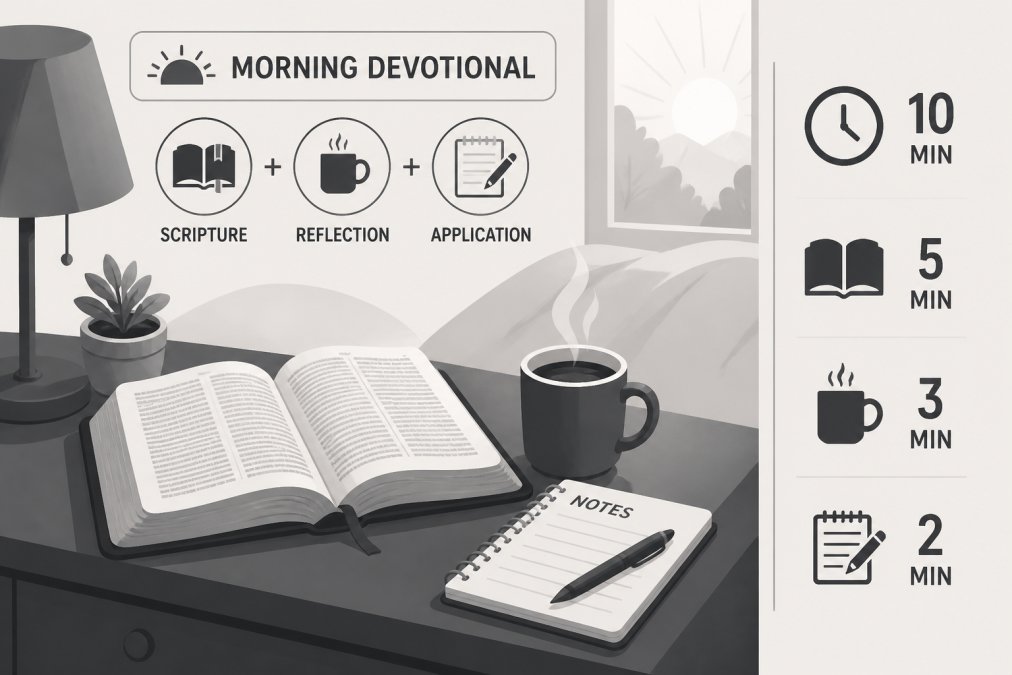
A devotion doesn’t need to be lengthy to be transformative. Many busy professionals find that ten to fifteen minutes with Scripture, reflection, and prayer sets the tone for their entire day.
A simple devotional structure works like this: Read a short passage (2-3 minutes). Reflect on what it means (3-4 minutes). Pray about it (3-4 minutes). Done.
Resources like Our Daily Bread provide free daily devotions specifically designed for working people. Each one is brief, focused, and written to speak directly to your day.
The beauty of short daily devotions is that they don’t require you to become a Bible scholar. They’re written for people like you, people with real jobs, real responsibilities, and real spiritual hunger. A devotion that challenges you to see God’s faithfulness in one small way is enough.
Many professionals keep a devotion open on their phone or tablet during breakfast or their morning commute. Others print them out. The format doesn’t matter. What matters is that you’re creating a space where God’s Word touches your day before the day overwhelms you.
Micro-Habits: Faith Under 60 Seconds
Sometimes practical faith for busy people means embracing the smallest possible actions. A micro-habit is something you can do in under a minute, yet it builds your spiritual connection throughout the day.
Here are micro-habits that work:
The Morning Gratitude Pause (30 seconds): Before checking your phone, name three things you’re grateful for. Thank God for each one. This primes your mind toward grace instead of anxiety.
The Midday Scripture Glance (20 seconds): Set a phone reminder for midday. When it goes off, open your Bible app and read one verse. That’s it. One verse can reorient your entire afternoon.
The Breath Prayer (45 seconds): Breathe in while praying, “Lord, help me.” Breathe out while praying, “I trust You.” Do this five times. It’s meditation rooted in faith.
The Evening Reflection (60 seconds): Before bed, ask yourself: “Where did I see God today?” Maybe it was in a kind word from a friend, a problem that worked out, or simply that you made it through. Acknowledge it. Thank Him for it.
These aren’t replacements for deeper prayer or Scripture study. They’re scaffolding, small practices that keep your spiritual connection alive throughout your day. Micro-habits work because they’re sustainable. You can do them anywhere, anytime, without special preparation.
The Psalms are full of people who prayed throughout their day, in brief moments. “Seven times a day I praise you for your righteous ordinances” (Psalm 119:164, NRSVCE). This isn’t seven lengthy prayer sessions. It’s seven moments of turning toward God.
Integrating Faith Into Your Daily Routine
Spiritual growth doesn’t require a separate compartment in your life. It grows when faith is woven into the fabric of your daily routine.
Morning Offering: Before you get out of bed, offer your day to God. “Lord, I offer you this day, my work, my relationships, my struggles. Help me see You in it all.” This simple practice transforms your mindset from “I have to get through today” to “God is with me in today.”
Mealtime Gratitude: Before eating, pause and give thanks. Not a rushed blessing, but a genuine moment of recognizing God’s provision. If you eat at your desk, at a restaurant, or in your car, a thirty-second pause still counts.
Work as Worship: Whatever your job, do it as if you’re doing it for Christ. Colossians 3:17 says, “And whatever you do, in word or deed, do everything in the name of the Lord Jesus, giving thanks to God the Father through him” (NRSVCE). This doesn’t mean your work becomes a ministry (though it might). It means you’re bringing your faith into your work, not leaving it at home.
Evening Examination: Before sleep, spend a few minutes reflecting. Where did you feel God’s presence today? Where did you miss Him? What do you regret? What are you grateful for? This practice, rooted in centuries of spiritual tradition, helps you notice God’s work in your day.
Family or Household Faith: If you have family, involve them. A brief blessing before dinner, a short Bible story at bedtime, or a weekend walk where you talk about faith, these moments shape everyone’s spiritual life.
The goal is not perfection but presence. Your daily routine is where faith actually lives. A rushed prayer at a red light, a moment of forgiveness with a coworker, choosing kindness when you’re tired, these are acts of faith.
Overcoming the ‘Too Busy’ Mindset
The biggest obstacle to practical faith for busy people isn’t actually time. It’s the belief that you don’t have enough of it, and the deeper fears hiding beneath that belief.
Consider this: You likely spend time scrolling social media, watching shows, or checking email multiple times daily. These aren’t criticisms; they’re realities. The question isn’t whether you have time. It’s whether you’re prioritizing your spiritual connection. But before you can prioritize it, you have to believe it’s worth protecting.
The real barriers are often invisible. Busy people don’t avoid faith because they lack time. They avoid it because:
Fear that faith won’t actually work. If you pray and nothing changes, if you read Scripture and still feel lost, if you ask God for help and the problem persists, what then? It’s safer to stay busy than to risk disappointment. But this fear keeps you from discovering that God’s faithfulness often looks different than we expect, not the removal of hardship, but His presence within it.
Shame about spiritual drift. You used to pray regularly. You used to read your Bible. Now you haven’t in months. The guilt is so heavy that returning feels impossible, like you’d have to apologize your way back into God’s good graces. But that’s not how grace works. Grace means you don’t have to earn your way back. You just have to turn around.
Competing values. You genuinely believe your work matters. Your family matters. Your health matters. And they do. But somewhere along the way, you’ve accepted the lie that spiritual growth is a luxury for people with margin, not a foundation for people under pressure. This is backward. The busier you are, the more you need spiritual grounding.
The belief that you have to be “spiritual enough” to pray. You think real prayer requires a certain discipline, a certain purity of heart, a certain readiness. So you wait until you feel ready. You wait until you’ve cleaned up your life, until you’re less angry, less distracted, less human. And you never pray, because that day never comes.
Reframing the choice. This requires a shift in perspective. You won’t “find” time for faith. You have to choose it. That choice looks like saying no to something else, even if it’s something good. It looks like protecting ten minutes in the morning instead of letting your phone dictate your first waking moments. It looks like admitting that your spiritual connection isn’t optional, it’s foundational.
Jesus Himself regularly withdrew to pray, even when crowds needed Him and His work was literally saving lives. “But he would withdraw to deserted places and pray” (Luke 5:16, NRSVCE). If Jesus, doing the most important work imaginable, prioritized prayer and solitude, how much more do we need it? He wasn’t being selfish. He was being wise. He knew that His connection to the Father was what made His work possible.
Start by naming what’s really stopping you. Is it fear? Shame? Competing priorities? Once you name it, you can address it. If it’s fear, ask yourself: What’s the worst that could happen if I pray and nothing changes? And then ask: What’s the cost of not praying? If it’s shame, remember that God’s first word to you is always welcome, never condemnation. If it’s competing priorities, ask yourself: What would change if I believed my spiritual health was as important as my work performance or my family’s needs? Because it is.
Practical Application for Today
Here’s what you can do right now:
Choose one micro-habit from this guide. Not all of them, one. The morning gratitude pause, the midday Scripture glance, or the evening reflection. Do it tomorrow. Then the next day. Build from there.
Pick a five-minute Scripture reading plan. Whether it’s a single Gospel chapter, the Psalms, or a structured plan through a Bible app, commit to reading five minutes daily for one week. Notice how it changes your perspective.
Identify one moment in your routine where you can pause. Maybe it’s your morning coffee, your lunch break, or your commute. That moment is now your spiritual anchor. Guard it.
Tell someone about your commitment. Accountability matters. Whether it’s a friend, a family member, or a faith community, sharing your intention makes it real.
Remember: practical faith for busy people isn’t about becoming someone you’re not. It’s about bringing your authentic self, tired, overwhelmed, imperfect, into God’s presence and letting Him meet you there.
Conclusion: Your Spiritual Connection Matters
Your life is full. Your calendar is packed. Your energy is stretched thin. In the midst of all this, God whispers: “Come to me, all you that are weary and are carrying heavy burdens, and I will give you rest” (Matthew 11:28, NRSVCE).
This isn’t an invitation to add more to your plate. It’s an invitation to find rest in the One who sustains it all. Practical faith for busy people means accepting that you don’t have to be perfect, disciplined, or extra-spiritual to encounter God. You just have to be willing.
Five minutes of Scripture. A whispered prayer during your workday. A moment of gratitude before sleep. These small acts of faith are real. They matter. They change you.
As you move forward, remember that your spiritual connection isn’t a luxury for people with free time. It’s a necessity for people with full lives. God designed it that way.
At BibleTopSearch.com, we believe that every Christian deserves access to clear, biblical answers without needing a theology degree. Whether you’re struggling with doubt, seeking practical guidance for daily life, or simply wanting to deepen your faith, we’re here to help you understand what Scripture truly says.
Explore more biblical answers on BibleTopSearch. Watch our in-depth video teachings, download your free Bible guide, and continue discovering how God’s Word speaks to your life today. Your journey of faith, no matter how busy you are, matters to God. Let’s grow together.
|
Practical Faith Method |
Time Required |
Best For |
Frequency |
|---|---|---|---|
|
Five-minute Scripture reading |
5 minutes |
Daily spiritual nourishment |
Daily |
|
Micro-habit (breath prayer, gratitude pause) |
Under 60 seconds |
Quick spiritual anchors throughout day |
Multiple times daily |
|
Short daily devotion |
10-15 minutes |
Deeper reflection with guidance |
Daily |
|
Morning offering |
2-3 minutes |
Setting spiritual intention for day |
Daily at wake |
|
Evening examination |
5 minutes |
Reflecting on God’s presence |
Daily before sleep |
Frequently Asked Questions
What are simple ways to pray during a busy workday?
Pause for 30 seconds between tasks to offer a quick prayer of gratitude or intercession. Use your commute for meditative prayer. Send a brief prayer text to a friend. The key is not length but intentionality. Jesus taught that sincere, brief prayers matter more than lengthy ones (Matthew 6:7). Even whispered prayers while working count as spiritual connection with God.
How can I keep God at the center of a hectic schedule?
Start your day with a 5-minute Bible passage and prayer, even before checking your phone. Use visual reminders like a cross on your desk or a Scripture verse on your screensaver. End your day reflecting on where you saw God's grace. Habit stacking—attaching faith practices to existing routines like morning coffee or lunch breaks—makes spiritual discipline sustainable without adding time pressure.
Can small acts of faith really make a difference?
Absolutely. Jesus emphasized that small acts done with genuine faith transform hearts and communities (Mark 12:41-44). A single kind word, a brief prayer, or five minutes of Scripture reading plants seeds of spiritual growth. Practical faith for busy people isn't about grand gestures but about consistent, small choices that reflect your relationship with God. These micro-habits create spiritual renewal over time.
What Bible verse can help a busy person find peace?
Philippians 4:6-7 offers powerful encouragement: 'Do not worry about anything, but in everything by prayer and supplication with thanksgiving let your requests be made known to God. And the peace of God, which surpasses all understanding, will guard your hearts and your minds in Christ Jesus' (NRSVCE). This verse reminds us that even in overwhelming seasons, we can pause to pray and experience divine presence and grace.