Table of Contents
- Short Answer: How to Find Peace in God
- Biblical Context: What God’s Peace Actually Means
- Bible Verses About Peace of Mind You Should Know
- Common Misunderstandings About Finding Peace in God
- How to Pray for Peace: A Step-by-Step Approach
- Trusting God in Hard Times: Surrendering Anxiety and Control
- Practical Application for Today: Daily Habits That Build Peace
- Worship, Scripture Meditation, and Renewing the Mind
- Conclusion: Peace in God Is a Relationship, Not a Formula
- Continue Your Bible Study with BibleTopSearch
Last Updated: August 6, 2026
Short Answer: How to Find Peace in God
Peace in God is the deep, settled calm that comes not from favorable circumstances, but from a living relationship with God himself. The Bible teaches that this kind of peace surpasses human understanding and is available to every believer, regardless of what they are facing.
At BibleTopSearch.com, we hear from readers every week who are exhausted by anxiety, overwhelmed by life’s hardships, and quietly wondering why they can’t seem to find the stillness they’re looking for. The short answer is this: peace in God is not a feeling you manufacture, it’s a gift you receive through trust, prayer, and an ongoing relationship with Christ.
Below, we’ll walk through exactly what the Bible says about this peace, clear up some common misunderstandings, and give you practical daily habits you can start today. Whether you’re brand new to faith or returning after a long season away, this guide is for you.
Biblical Context: What God’s Peace Actually Means
Most people think of peace as the absence of problems. Scripture tells a very different story.
The Hebrew word for peace, shalom, carries a meaning far richer than "no conflict." It describes wholeness, completeness, and well-being in every dimension of life. The New Testament Greek word eirene carries a similar weight: a harmony and rest that comes from being rightly connected to God.
This is peace that exists within hardship, not only after it. The Apostle Paul wrote from prison when he described a peace that "surpasses all understanding" (Philippians 4:7, NRSVCE). He wasn’t free from trouble. He was free inside trouble.
As documented in the United States Conference of Catholic Bishops’ pastoral resources on peace and prayer, the Catholic tradition has long understood peace as an interior gift of the Holy Spirit, rooted in the theological virtues of faith, hope, and charity. It is not a technique. It is a fruit of communion with God.
The Difference Between Worldly Peace and God’s Peace
Worldly peace depends on conditions being right: financial security, healthy relationships, a stable future. God’s peace depends on one thing: trust in him.
Jesus draws this contrast explicitly in John 14:27 (NRSVCE): "Peace I leave with you; my peace I give to you. I do not give to you as the world gives. Do not let your hearts be troubled, and do not let them be afraid."
The world’s peace is conditional and fragile. God’s peace is unconditional and anchored in his unchanging character. This distinction matters enormously for anyone who has tried to "feel better" about a situation and found that the anxiety keeps returning. The problem isn’t a lack of effort. It’s that worldly peace was never designed to hold the weight we place on it.
Bible Verses About Peace of Mind You Should Know
Scripture is full of promises about peace. These are not vague encouragements, they are specific, actionable assurances you can return to again and again.
Here are the key passages every believer should have close at hand:
-
Philippians 4:6-7 (NRSVCE): "Do not worry about anything, but in everything by prayer and supplication with thanksgiving let your requests be made known to God. And the peace of God, which surpasses all understanding, will guard your hearts and your minds in Christ Jesus." This is the clearest biblical instruction on anxiety and peace together.
-
Isaiah 26:3 (NRSVCE): "Those of steadfast mind you keep in peace, in peace because they trust in you." Peace is linked directly to where the mind is fixed. Steadfastness in trust produces inner calm.
-
John 16:33 (NRSVCE): "I have said this to you, so that in me you may have peace. In the world you face persecution. But take courage; I have conquered the world!" Jesus does not promise a trouble-free life. He promises that peace is found in him, even when the world is difficult.
-
Romans 8:6 (NRSVCE): "To set the mind on the flesh is death, but to set the mind on the Spirit is life and peace." Renewing the mind, a recurring theme in Paul’s letters, is directly connected to experiencing peace.
-
Psalm 46:10 (NRSVCE): "Be still, and know that I am God!" Sometimes the path to peace begins with simply stopping, quieting the noise, and acknowledging God’s sovereignty.
These Bible verses about peace of mind are not magic words. They are invitations to orient your whole self toward God. Read them slowly. Let them sink in.
Common Misunderstandings About Finding Peace in God
A few widespread misconceptions keep many sincere believers stuck.
Misunderstanding 1: Peace means you won’t feel anxious anymore.
Many people expect that once they "find peace," anxiety will simply disappear. Scripture never promises the complete absence of anxious feelings. What it promises is that God’s peace will guard your heart and mind (Philippians 4:7). A guard doesn’t prevent the attack. It stands firm against it. Anxiety may still arise; peace in God means you are not ruled by it.
Misunderstanding 2: If you’re not at peace, your faith must be weak.
This is a particularly harmful idea because it adds shame to an already difficult experience. The Psalms are filled with cries of anguish, confusion, and even despair from people of deep faith. Psalm 22:1 (NRSVCE) opens with "My God, my God, why have you forsaken me?", words Jesus himself quoted from the cross. Struggling is not the opposite of faith. It is often where faith deepens.
Misunderstanding 3: Peace is a destination you arrive at once.
Peace in God is better understood as a daily posture than a permanent achievement. It requires ongoing surrender, regular prayer, and consistent time in Scripture. Most people find it fluctuates, and that is completely normal.
Misunderstanding 4: You have to have everything figured out first.
Many people delay seeking peace because they feel they need to resolve their doubts or fix their behavior first. But the biblical pattern is the opposite: come as you are, and let God’s presence do the transforming work.
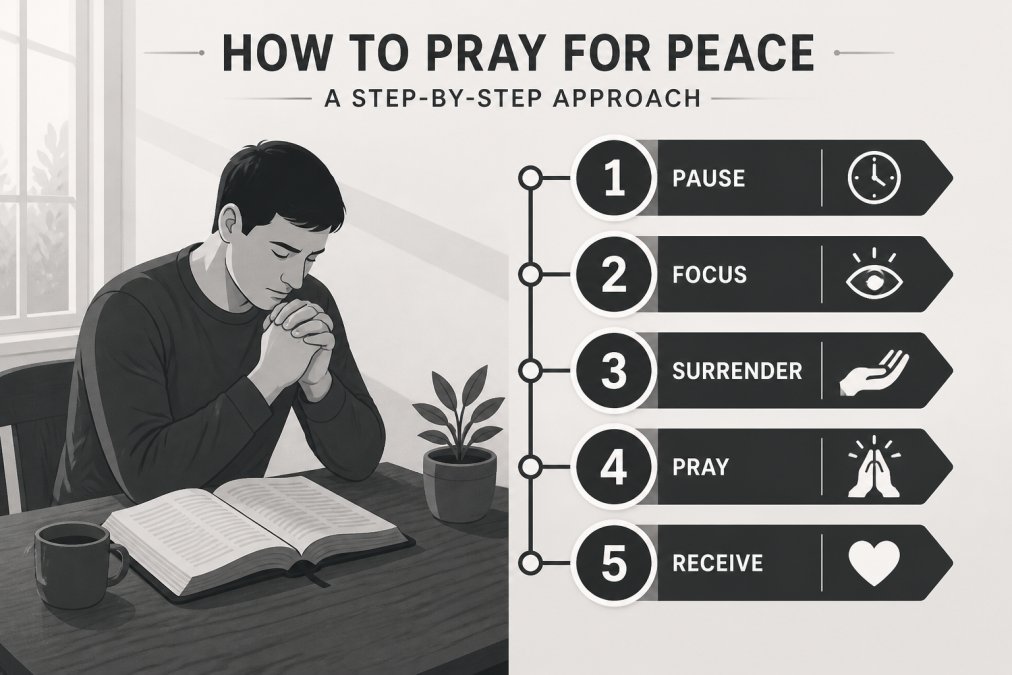
How to Pray for Peace: A Step-by-Step Approach
Prayer is the primary channel through which peace in God flows. This is not just a spiritual observation, research from the American Psychological Association’s resources on prayer and mental health has explored how contemplative prayer practices correlate with reduced anxiety and improved emotional regulation. But beyond the psychological dimension, prayer is the act of bringing yourself honestly into God’s presence.
Here is a simple, practical approach you can use today:
-
Find a quiet place. Even five minutes of genuine quiet is better than an hour of distracted prayer. Remove your phone from the room if possible.
-
Begin with acknowledgment. Start by acknowledging who God is, not what you need. A single line works: "Lord, you are good, and you are here." This reorients your heart before you speak your requests.
-
Name what is troubling you. Be specific and honest. God already knows, but the act of naming your anxiety out loud (or in writing) is itself a form of surrender. Don’t edit yourself.
-
Bring your prayer requests. Philippians 4:6 says to make your requests known "with thanksgiving." Include something you are genuinely grateful for, even if it feels small. Gratitude shifts the posture of the heart.
-
Sit in silence. After speaking, wait. This is the part most people skip. Silence in prayer is not empty, it is an act of trust that God will respond in his own way and time.
-
Close with surrender. End with something like: "Lord, I give this to you. I trust your care more than my own understanding."
What to Say When You Don’t Know Where to Start
This is one of the most common struggles in prayer, and it’s worth addressing directly. If you sit down to pray and simply don’t know what to say, try this:
- Use a Psalm. Read Psalm 23 or Psalm 91 aloud as your prayer. Let Scripture speak when your own words fail.
- Pray the Lord’s Prayer slowly, pausing on each phrase.
- Simply say: "God, I don’t know how to pray right now. I’m here. Please meet me." That honesty is itself a prayer.
The Catholic tradition also offers the Rosary and the Liturgy of the Hours as structured forms of daily prayer that have helped countless believers maintain a consistent quiet time with God.
Trusting God in Hard Times: Surrendering Anxiety and Control
Surrendering control is probably the hardest part of finding peace, because it runs directly against our instinct to fix, manage, and anticipate every outcome.
The biblical call to "cast your burdens on the Lord" (Psalm 55:22, NRSVCE) is not a passive resignation. It is an active, repeated choice to release what you were never designed to carry alone.

Trusting God in hard times means accepting that his ways and timing are not always visible to us. Isaiah 55:8-9 (NRSVCE) puts it plainly: "For my thoughts are not your thoughts, nor are your ways my ways, says the Lord." This is not a dismissal of your pain. It is an invitation to trust a perspective larger than your own.
There is also a physiological dimension worth naming. Chronic anxiety keeps the body in a state of stress arousal, elevated cortisol, disrupted sleep, a narrowed sense of what is possible. Spiritual practices of surrender, prayer, and scripture meditation are not just emotionally helpful; they engage the nervous system’s capacity for rest and restoration. Faith and human physiology are not separate systems. They interact.
Reflection Prompts to Help You Surrender
Use these questions in your journal or quiet time to move from anxiety toward surrender:
- What specific outcome am I trying to control right now? What would it look like to release that to God?
- Is my fear based on something that is actually happening, or something I am imagining might happen?
- What has God already brought me through? What does that tell me about his faithfulness now?
- Where in my life am I trusting my own understanding more than God’s guidance?
- What would I say to a close friend carrying this same burden? Can I receive that same grace for myself?
These prompts are not one-time exercises. Return to them whenever peace feels distant.
Practical Application for Today: Daily Habits That Build Peace
Peace in God doesn’t arrive in a single moment and stay forever. It is built through daily, consistent spiritual discipline. Think of it less like a switch and more like a muscle: it grows with use.
Here is a practical framework for building peace into your everyday life:
| Daily Habit | What It Does | When to Practice |
|---|---|---|
| Morning Scripture reading | Anchors the mind in biblical truth before the day’s noise begins | First 10-15 minutes after waking |
| Prayer with thanksgiving | Shifts focus from anxiety to divine presence | Morning and evening |
| Midday pause | Interrupts the stress cycle and reorients toward God | Lunchtime or any natural break |
| Scripture meditation | Renewing the mind by dwelling on a single verse | Throughout the day |
| Journaling reflection | Processes emotions honestly before God | Evening |
| Worship (music or liturgy) | Lifts the heart above circumstances | Morning, commute, or evening |
The goal is not to perform all six perfectly every day. Start with one. Many people find that morning Scripture reading, even just five minutes, changes the entire tone of their day.
Troubleshooting Spiritual Dryness When Peace Feels Distant
Spiritual dryness is a real and common experience. You pray, you read, and nothing seems to happen. The peace you once felt seems unreachable.
A few things worth knowing:
Dryness is not abandonment. The mystics of the Catholic tradition, including St. John of the Cross, described what he called the "dark night of the soul", a season where God feels absent but is, in fact, drawing the soul into a deeper, less emotion-dependent faith. Feelings are not the measure of God’s presence.
Check the basics. Are you sleeping? Eating? Moving your body? Physical depletion mimics spiritual emptiness. Sometimes the most spiritual thing you can do is rest.
Change your posture. If silent prayer feels dry, try praying aloud. If individual prayer feels hollow, try attending Mass or a prayer group. If reading Scripture feels flat, try listening to it. The Holy Spirit is not limited to one channel.
Bring the dryness to God directly. Pray: "Lord, I feel nothing right now. I’m showing up anyway." That kind of honest faithfulness is itself a profound act of trust.
Worship, Scripture Meditation, and Renewing the Mind
Worship and scripture meditation are two of the most underused pathways to peace in God, particularly for people who are new to faith or returning after a long absence.
Worship is not just singing songs in church. Worship is any act that orients your heart toward God’s greatness and goodness. It can be music, yes, but it can also be a walk in nature with a spirit of gratitude, or a moment of silent awe before the Eucharist, or reading a Psalm aloud as an act of praise.
The effect of genuine worship on anxiety is striking. When you shift your attention from the size of your problem to the greatness of God, the problem doesn’t disappear, but your perspective on it changes. This is exactly what Philippians 4:8 (NRSVCE) prescribes: "Whatever is true, whatever is honorable, whatever is just, whatever is pure, whatever is pleasing, whatever is commendable, if there is any excellence and if there is anything worthy of praise, think about these things."
Scripture meditation is different from reading. Reading moves through a passage. Meditation sits with a verse, turns it over, asks questions of it, and allows it to speak into a specific situation. The Psalms are particularly suited to this practice. As noted in the Vatican’s official resources on Lectio Divina and scriptural prayer, the ancient Catholic practice of Lectio Divina, sacred reading, offers a structured way to move from reading Scripture to praying it to living it.
Renewing the mind, as Paul describes in Romans 12:2 (NRSVCE), is not a passive process. It requires actively replacing anxious, fear-driven thought patterns with scriptural truth. Over time, this is how the peace of God becomes not just a momentary experience but a settled orientation of the soul.
Conclusion: Peace in God Is a Relationship, Not a Formula
The biggest mistake people make when searching for peace in God is treating it like a problem to solve rather than a relationship to cultivate.
You cannot earn peace. You cannot achieve it through the right combination of spiritual techniques. Peace in God is a fruit that grows in the soil of trust, surrender, and daily communion with him. It is available to you right now, in whatever season you are in.
If you are struggling today, start small. Open the Bible to Psalm 23. Pray one honest sentence. Sit in silence for two minutes. These are not small things. They are the beginning of a relationship that, over time, produces the deepest peace the human soul can know.
The divine comfort God offers is not a feeling reserved for the spiritually advanced. It is a promise extended to every person willing to turn toward him.
Continue Your Bible Study with BibleTopSearch
If this guide has been helpful, there is much more waiting for you at BibleTopSearch.com. Our free resources are designed specifically for readers like you, people who want real, biblically faithful answers without needing a theology degree to understand them.
Here is what we invite you to do next:
- Download the free Bible guide on peace and anxiety, packed with carefully selected Scripture passages and practical reflection questions you can use in your daily devotion.
- Watch the corresponding YouTube video teaching that walks through these passages in greater depth, with visual examples and a warm, accessible format.
- Explore more Bible Answers on topics like prayer, forgiveness, doubt, and faith, all written in the same Scripture-first, compassionate voice you’ve found here.
As the Catechism of the Catholic Church’s teaching on prayer and peace affirms, peace is the fruit of a life ordered toward God. BibleTopSearch.com exists to help you take that next step, wherever you are starting from.
You don’t have to have it all figured out. You just have to begin.
Frequently Asked Questions
What does the Bible say about the peace of God?
The Bible describes God's peace as something that goes beyond human comprehension. Philippians 4:7 (NRSVCE) says it 'surpasses all understanding' and guards both heart and mind in Christ Jesus. Unlike worldly peace, which depends on circumstances, God's peace is a spiritual gift rooted in a living relationship with Him. It arrives through prayer, trust, and surrendering anxiety to God rather than through solving every problem on your own.
How can I find peace in God during difficult times?
Finding peace in God during hard seasons starts with honest prayer, bringing your exact fears and burdens to Him rather than polished words. Reading and meditating on scriptural promises, especially Psalms and the letters of Paul, anchors your mind in biblical truth. Trusting God in hard times also means releasing the need to control outcomes. Small daily habits, like quiet time, worship, and reflection, build the kind of steadfastness that carries you through difficulty without requiring the circumstances to change first.
How can I find peace while waiting on God?
Waiting on God is one of the hardest spiritual disciplines, but Scripture consistently frames it as an active posture, not passive resignation. Isaiah 40:31 (NRSVCE) promises that those who wait on the Lord will renew their strength. During seasons of waiting, Scripture meditation, worship, and journaling your prayer requests help you stay connected to God's divine presence. Reminding yourself of past moments when God came through also builds the trust and faith needed to remain steady.
Is there a difference between worldly peace and God's peace?
Yes, the difference is significant. Worldly peace is conditional: it arrives when problems are resolved, relationships are stable, or finances are secure. God's peace, as described in John 14:27 (NRSVCE), is given directly by Jesus and is not dependent on external circumstances. It coexists with difficulty, grief, and uncertainty. That is why Paul could write about contentment from prison. God's peace is an inner calm rooted in divine comfort and trust, not in favorable conditions.
Finding peace in God is one of the most searched questions in the Christian faith, and for good reason. Anxiety, uncertainty, and hardship are universal human experiences. BibleTopSearch.com offers a free, accessible place to keep returning to as you grow in your relationship with Christ. Download your free guide now and take the next step in your faith.