
Table of Contents
- Short Answer: What Are Easy Bible Explanations for Adults?
- Biblical Context: Why Understanding Scripture Matters
- How to Read the Bible for Beginners
- Understanding the Structure of the Bible
- The Importance of Context in Scripture
- Best Bible Study Tools for Beginners
- How to Use a Bible Commentary
- Key Themes and Major Stories in Scripture
- Common Misunderstandings About Bible Reading
- Practical Application for Today
- Conclusion: Your Journey Begins Here
- Encourage Further Bible Study
Last Updated: August 10, 2026
Short Answer: What Are Easy Bible Explanations for Adults?
Easy Bible explanations for adults are simplified, accessible interpretations of Scripture designed for readers without formal theological training. They break down complex biblical passages, historical context, and theological themes into language anyone can understand. Rather than requiring a theology degree, these explanations meet you where you are, whether you’re new to Bible reading, returning to faith after years away, or wrestling with specific questions about what Scripture actually says.
At BibleTopSearch.com, we understand that many adults feel intimidated by the Bible’s length, historical distance, and theological complexity. Our approach focuses on clarity without sacrificing depth, helping you grasp not just what the Bible says, but why it matters for your life today.
Biblical Context: Why Understanding Scripture Matters
The Bible isn’t meant to be a mystery reserved for scholars. Throughout Scripture, God invites ordinary people into relationship with Him through His Word. When Jesus taught, He used parables and everyday language so common people could understand profound truths. The Apostle Paul wrote letters to churches, regular believers, not academic institutions.
Understanding Scripture matters because it shapes how you see God, yourself, and the world. When you grasp what the Bible actually teaches rather than what you’ve assumed it teaches, you gain clarity during seasons of doubt, comfort during suffering, and direction for daily decisions. According to Pew Research Center studies on Bible reading, Americans who engage regularly with Scripture report greater spiritual confidence and peace, yet many avoid Bible study because they find it overwhelming.
The good news: the Bible becomes far less intimidating once you understand its basic structure, learn how to read different types of passages, and discover tools that help you study effectively. You don’t need years of seminary training to understand God’s Word. You need the right approach and resources.
How to Read the Bible for Beginners
Starting a Bible reading habit is one of the most important steps in your spiritual growth, but knowing where to begin matters enormously. Many people open the Bible to Genesis and quit by Leviticus. Others jump randomly between passages and miss the connected storyline. The right starting point makes all the difference.
 Start with the Gospels
The four Gospels, Matthew, Mark, Luke, and John, tell the story of Jesus’s life, teaching, death, and resurrection. They’re the heart of the New Testament and the easiest entry point for new readers. Each Gospel writer emphasizes different aspects of Jesus’s ministry: Matthew highlights Jesus as the fulfillment of Old Testament prophecy, Mark shows His power and authority, Luke emphasizes His compassion and inclusion of outsiders, and John explores His divine nature and spiritual significance.
Start with the Gospel of Mark. It’s the shortest, most action-packed Gospel, and it moves quickly. You’ll read about Jesus healing the sick, teaching in parables, challenging religious authorities, and ultimately dying and rising again. As you read, you’ll encounter Jesus’s core message: God loves you, wants to transform your life, and offers forgiveness and redemption through faith in Him.
Read Mark in one sitting if possible, or across a few days. Let the narrative flow carry you. Don’t worry about understanding every detail yet, that comes later. Your goal is to meet Jesus and grasp the basic story.
Read in Short Sessions
Consistency beats intensity. Reading the Bible for 15 minutes daily will transform your understanding far more than reading for three hours once a month. Short, regular sessions help you retain what you read, build the habit into your routine, and give the Holy Spirit time to work the truth into your heart.
Many people find that reading Scripture first thing in the morning, before checking their phone or email, creates space for genuine reflection. Others read during lunch or before bed. The best time is whenever you’ll actually do it. Start with a single chapter per day. That’s manageable, sustainable, and enough to make real progress.
As you read, keep a notebook nearby. Write down questions, observations, or verses that stand out to you. This simple practice deepens your engagement and creates a record of what God is teaching you over time.
Use a Translation That Speaks to You
The Bible exists in dozens of English translations, each with a different approach. Some prioritize word-for-word accuracy (like the New Revised Standard Version Catholic Edition), while others emphasize readability and meaning (like the New Living Translation). No translation is “perfect”, each involves choices about how to convey ancient Hebrew and Greek into modern English.
For beginners, readability matters. The New Revised Standard Version Catholic Edition balances accuracy with clarity, making it ideal for study. The New Living Translation reads smoothly and is excellent for devotional reading. The Message is highly paraphrased but wonderfully accessible for those completely new to Scripture.
Pick one translation and stick with it for at least three months. Switching between translations constantly fragments your reading and makes it harder to build familiarity with Scripture’s flow and language.
Understanding the Structure of the Bible
The Bible’s organization confuses many new readers. Why does the order seem random? Understanding the basic structure transforms the Bible from an intimidating brick of text into a coherent narrative.
Old Testament vs. New Testament Overview
The Bible divides into two major sections: the Old Testament and the New Testament. The Old Testament (46 books) tells the story of God’s relationship with Israel from creation through the centuries leading up to Jesus’s birth. The New Testament (27 books) focuses on Jesus’s life and the early church’s development.
While Protestant Old Testaments contain 39 books, the Catholic canon includes 7 additional deuterocanonical books: Tobit, Judith, 1 and 2 Maccabees, Wisdom, Sirach, and Baruch, along with additions to Esther and Daniel. Hence, a Catholic Bible has 46 books in the Old Testament.
The Old Testament isn’t obsolete, it’s foundational. It reveals God’s character, shows humanity’s tendency toward sin, and contains hundreds of prophecies that Jesus fulfilled. When Jesus quoted Scripture, He quoted the Old Testament. When He taught, He referenced Old Testament stories. Understanding the Old Testament deepens your grasp of the New Testament’s significance.
The New Testament begins with four Gospels (Matthew, Mark, Luke, John), followed by Acts (the early church’s story), Paul’s letters to various churches, and other epistles. It concludes with Revelation, which describes the end times and Christ’s return.
The Canon: How We Know Which Books Belong
The word “canon” refers to the official list of books considered Scripture. You might wonder: why these 73 books and not others? How did the early church decide?
The canon wasn’t arbitrarily chosen. Over centuries, the church recognized which books bore the marks of apostolic authority, doctrinal reliability, and widespread acceptance among believers. Books included in the canon were written by apostles or their close associates, taught consistent theology with other Scripture, and were used in worship across the early church. This process happened gradually, by the late 300s, church councils formally recognized the 73 books we have today.
As mentioned before, the Catholic tradition includes additional books called the Deuterocanonical books (or Apocrypha), which appear in Catholic Bibles but not in most Protestant translations. The New Revised Standard Version Catholic Edition includes these books, providing a complete Catholic perspective on Scripture.
The Importance of Context in Scripture
One of the biggest mistakes in Bible reading is taking verses out of context. A single sentence can mean something completely different when you understand what comes before and after it, who wrote it, when it was written, and why.
Historical and Cultural Context
The Bible spans over 1,000 years of history across multiple cultures. Understanding the historical and cultural background transforms your interpretation. For example, when Jesus told the rich young ruler to “sell all that you own and distribute the money to the poor” (Luke 18:22, NRSVCE), He wasn’t establishing a universal law that all Christians must be poor. He was addressing this specific person’s particular obstacle to faith, his attachment to wealth. The principle is about removing barriers between you and God, not about poverty itself.
Similarly, cultural practices that seem strange to modern readers made perfect sense in their original context. When Job’s friends sat with him in silence for seven days after his suffering, they were showing deep respect and solidarity. When Jesus washed His disciples’ feet, He performed a servant’s task that showed radical humility. Understanding these cultural norms helps you grasp what Scripture is actually communicating.
Pay attention to who is speaking, to whom, and under what circumstances. A command to ancient Israel about religious practices might not apply directly to you today, but the underlying principle often does. This is where study tools and commentaries become invaluable.
Literary Structure and Genre
The Bible contains multiple literary genres: historical narrative, poetry, prophecy, parables, epistles, and apocalyptic literature. Reading a parable as if it’s a scientific explanation will lead you astray. Interpreting poetic language literally will confuse you.
When Jesus said, “I am the door” (John 10:7, NRSVCE), He wasn’t claiming to be made of wood. He was using metaphorical language to teach that He is the way to salvation. When the Psalms describe God’s “wings” and “shield,” they’re using poetic imagery to express God’s protection and care, not claiming God has literal wings.
Learning to recognize genre helps you interpret Scripture accurately. Historical narratives should be read as history. Poetry should be read for its emotional and theological truth. Parables should be read for the spiritual principle they teach. This skill develops as you read more and begin to notice patterns.
Best Bible Study Tools for Beginners
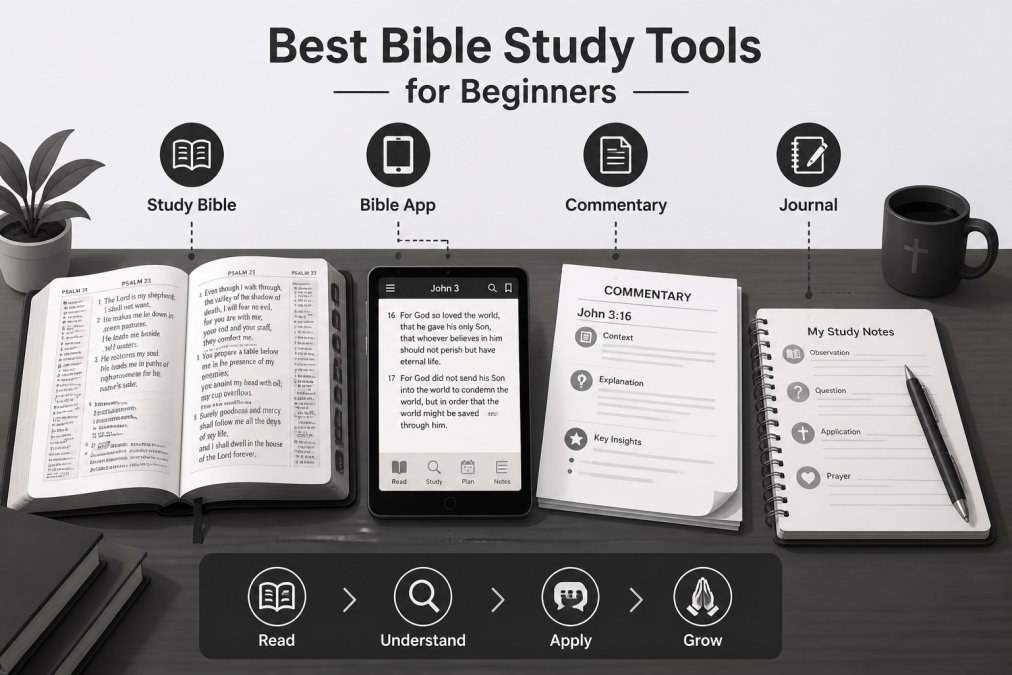
You don’t need many tools to study the Bible effectively, but the right ones make a significant difference. The key is choosing tools that match your learning style and schedule, then resisting the urge to add more. Many new Bible readers make the mistake of collecting every available resource, which creates overwhelm instead of clarity.
Study Bibles and Devotional Resources
A study Bible includes the biblical text plus notes, cross-references, maps, and explanatory articles. The notes explain difficult passages, provide historical context, and highlight key themes. For Catholic readers, the New Revised Standard Version Catholic Edition study Bible offers faithful Catholic interpretation alongside the Scripture text.
When choosing a study Bible, consider these factors:
Margin width and font size. If you plan to write notes directly in your Bible, you need adequate margin space. If you have vision challenges, larger fonts matter. Some study Bibles prioritize notes over margin space, while others balance both.
Note density. Some study Bibles include extensive notes on every verse, which is helpful for deep study but can feel overwhelming during devotional reading. Others include notes only on key passages, allowing more white space and faster reading. The Ignatius Catholic Study Bible, for example, includes substantial notes grounded in Catholic tradition and Church teaching. The New American Bible Revised Edition study editions offer different note levels depending on the version you choose.
Organization and accessibility. Some study Bibles include topical indexes, making it easy to find passages about forgiveness, suffering, or other themes. Others include timelines, maps, or articles on biblical history. Consider what features you’ll actually use.
Devotional resources guide you through Scripture with daily readings, reflections, and prayers. Many Catholics find that combining a study Bible with a devotional resource creates a balanced practice: the study Bible for deeper understanding on days when you have time, the devotional for spiritual nourishment and prayer on busier days.
A practical workflow: Read your chosen passage in the study Bible first, without consulting notes. Write down what you observe and any questions that arise. Then read the study Bible notes to deepen your understanding. This sequence keeps you engaged with Scripture itself rather than jumping straight to expert commentary.
Digital Tools and Apps
Catholic Bible apps and digital resources can make Scripture study more accessible, whether you are looking for daily readings, Catholic commentary, or a deeper understanding of the Bible in light of Church teaching. Apps such as Laudate, Hallow, and Verbum Catholic Bible Software offer different levels of study and spiritual formation.
Laudate is a free Catholic app that brings together many useful resources in one place, including the daily Mass readings, the Liturgy of the Hours, prayers, the Rosary, the Stations of the Cross, and access to the Catechism of the Catholic Church. It is particularly helpful for Catholics who want Scripture to be part of their daily prayer life. The downside is that its large collection of resources can make the interface feel somewhat crowded, especially for new users.
Hallow approaches Scripture primarily through prayer and spiritual formation. Along with Catholic prayers, meditations, the Rosary, and other devotional resources, it offers guided Scripture experiences and Bible-based prayer. This makes it especially helpful for people who want not only to read Scripture but also to pray with it. Some content is available for free, while its larger library requires a paid subscription.
Verbum Catholic Bible Software, developed specifically for Catholic study, is the most comprehensive option for readers who want to go deeper. It combines Scripture with Catholic commentaries, Church documents, writings of the Church Fathers, the Catechism, original-language tools, and other theological resources. Its powerful search features can help users explore how Scripture connects with Catholic teaching and Tradition. However, Verbum has a steeper learning curve and may provide far more depth than a beginner needs.
For beginners, a simple Catholic Bible app or Laudate may be the easiest place to start. Those who want Scripture integrated with guided prayer may prefer Hallow, while readers ready for serious Catholic biblical and theological study may find Verbum especially valuable.
Whichever digital tool you choose, remember that an app is only a tool. For Catholics, Scripture is best understood within the living faith of the Church—in harmony with Sacred Tradition, the Magisterium, and the sacramental and liturgical life of the Church.
Key trade-offs to consider:
- Screen fatigue vs. portability. Reading Scripture on a phone or tablet is convenient and searchable, but some people find that reading on a screen creates a different spiritual experience than holding a physical Bible. Many readers benefit from a hybrid approach: a physical Bible for devotional reading and a digital tool for study and searching.
- Distraction risk. A Bible app on your phone is always one swipe away from email, social media, and notifications. If you struggle with phone distractions, a physical Bible eliminates this temptation.
- Offline access. Most Bible apps require an internet connection to download content, but once downloaded, work offline. If you read during a commute or in areas with poor connectivity, verify that your chosen app supports offline use.
- Synchronization across devices. If you read on your phone during lunch and your tablet at night, a good app syncs your progress and notes across both. This consistency is valuable for building the habit.
A practical workflow: If you’re just starting, begin with a simple Catholic Bible app or Laudate on your phone. It’s free and gives you easy access to Scripture, including the daily Mass readings, while also connecting your Bible reading with Catholic prayer and the liturgical life of the Church. As your practice deepens, consider adding a good Catholic study Bible for more detailed notes and commentary. If you eventually want to explore Scripture alongside the Catechism, Church documents, the writings of the Church Fathers, and Catholic biblical scholarship, a more comprehensive resource such as Verbum can help take your study further.
Bible Reference Materials
A Bible concordance lists every occurrence of a word in Scripture, helping you trace themes throughout the Bible. A Bible dictionary explains terms, customs, and concepts. A Bible atlas shows geographical locations and historical movements.
These tools were traditionally printed books, but most now exist digitally within Bible apps or websites. When you encounter an unfamiliar term like “phylactery” or “ephod,” a quick search in a Bible dictionary clarifies what it meant in its original context.
How to use them effectively: Don’t consult reference materials before reading the passage itself. Read the Scripture first, form your own initial understanding, then use reference tools to deepen that understanding. This sequence keeps you engaged with God’s Word rather than relying on expert interpretation from the start.
BibleTopSearch.com provides curated explanations of the ten most searched Bible questions, offering the kind of clarity these reference materials provide in an even more accessible format. Our approach simplifies complex theological topics without requiring you to purchase multiple reference books.
Avoiding Tool Overload
The biggest mistake new Bible readers make is collecting too many resources. You don’t need a study Bible, a devotional guide, three Bible apps, a commentary series, a Bible dictionary, and a concordance. You need one or two tools that match your learning style and schedule.
Start with this minimum: a physical study Bible (or a single Bible app) and a notebook. That’s enough to build a meaningful practice. As you develop consistency and identify specific questions, add one additional resource, perhaps a commentary or a second app for comparison. Resist the urge to add more until you’ve actually used what you have.
How to Use a Bible Commentary
A Bible commentary is a book (or digital resource) where scholars explain Scripture passage by passage. Commentaries range from simple devotional explanations to dense academic analyses. For beginners, choosing the right commentary level is crucial, too simple and you won’t gain real insight, too complex and you’ll feel lost.
What a Commentary Does
A commentary explains what a passage meant in its original context, what it teaches theologically, and often how it applies today. It answers questions like: Why did Jesus say this? What does this Old Testament law mean? How does this passage connect to the rest of Scripture?
Good commentaries don’t tell you what to think; they help you understand what Scripture says so you can form your own convictions. They provide historical background, linguistic insights, and theological framework without replacing your own engagement with the text.
Commentaries also reveal how different Christian traditions interpret the same passages. A Catholic commentary emphasizes how a passage connects to Church teaching and tradition. An evangelical commentary might emphasize personal conversion and faith. An academic commentary explores the original Hebrew or Greek language and historical context. None of these approaches is “wrong”, they’re different lenses on the same text.
Choosing a Commentary That Fits Your Level
Commentaries exist at different levels of complexity. Choosing the right level for your current stage is essential.
Devotional commentaries are written for spiritual formation rather than academic study. They’re brief, accessible, and focus on how a passage applies to your life today. Examples include the Ignatius Catholic Study Bible (which includes substantial notes grounded in Catholic tradition) and the Life Application Study Bible (which emphasizes practical application). These are ideal if you’re reading for spiritual growth and don’t want to get bogged down in historical details.
Mid-level commentaries balance accessibility with scholarly depth. They explain the historical and cultural context, note important theological themes, and offer application without requiring you to know Greek or Hebrew. The MacArthur Study Bible offers evangelical interpretation at this level. The Catechism of the Catholic Church provides authoritative Catholic teaching on Scripture passages, though it’s organized by doctrine rather than by biblical book. For Catholic readers seeking mid-level commentary, the Navarre Bible series offers scholarly notes grounded in Catholic tradition and papal teaching.
Academic commentaries assume theological training and often include original language analysis. The Expositor’s Bible Commentary series balances scholarship with readability better than most academic works, making it accessible to serious students. The Anchor Bible Commentary series is highly detailed and scholarly. These are best used after you’ve built foundational understanding through devotional or mid-level commentaries.
How to choose: Start with one commentary rather than consulting five different ones. Consistency helps you develop familiarity with one scholar’s approach and theology. Ask yourself: Am I reading for spiritual growth or academic understanding? Do I want practical application or historical context? How much time do I have? A busy parent reading for spiritual nourishment should choose a devotional commentary. A retired adult with time for deeper study might choose a mid-level or academic commentary.
Verse-by-Verse Analysis and Deeper Study
The most helpful approach for beginners is verse-by-verse analysis. Rather than reading a commentary cover-to-cover, read a Scripture passage first, then look up those specific verses in a commentary. This method keeps you anchored to the text while gaining expert insight.
For example, if you’re reading John 3:16 and want to understand what “born again” means, you’d look up that passage in a commentary. The commentary would explain that “born again” refers to spiritual rebirth through faith in Christ, contrast it with physical birth, and show how this concept appears elsewhere in Scripture.
A practical workflow:
- Read the passage in your Bible first. Don’t consult the commentary yet. Read slowly and note any words, phrases, or ideas that confuse you or stand out.
- Write down your observations. What does this passage seem to be saying? Who is speaking? To whom? Under what circumstances? What questions do you have?
- Then consult the commentary. Look up the specific verses that confused you or intrigued you. Read the commentary’s explanation. Does it clarify your questions? Does it add important context you missed?
- Reflect on what you’ve learned. How does the commentary’s explanation change your understanding? Does it challenge any assumptions you held? What will you remember from this passage?
This approach prevents commentary from becoming a substitute for reading Scripture itself. Your primary engagement is with God’s Word; the commentary is a helpful tool, not the main event.
Common Commentary Pitfalls to Avoid
Over-reliance on commentary. Some readers consult a commentary before reading Scripture, essentially reading the commentary’s summary instead of engaging with the text itself. This approach robs you of the experience of wrestling with Scripture directly. Always read the passage first.
Assuming one commentary is definitive. Different commentaries offer different insights. A passage might have multiple valid interpretations supported by Scripture. A good commentary acknowledges these differences rather than claiming one interpretation is obviously correct. If you encounter a passage where commentaries disagree, that’s an invitation to study deeper, not a sign that something is wrong.
Choosing a commentary based on author reputation alone. A well-known scholar might write a commentary that’s too academic for your current level, or too focused on one theological tradition. Read sample pages or reviews before purchasing. Many libraries carry commentaries, allowing you to test-drive them before buying.
Treating commentary notes as Scripture. The commentary is human interpretation of Scripture, not Scripture itself. A commentary can be wrong. Scripture cannot. If a commentary contradicts what you read in the Bible, trust Scripture and consider consulting a different commentary or a trusted spiritual mentor.
Making Commentary Part of Your Regular Practice
Many new Bible readers treat commentaries as emergency resources, consulted only when completely stuck. A more effective approach is integrating commentary into your regular study rhythm.
For daily reading: Use a devotional commentary or study Bible notes. These are brief enough to fit into a 15-minute reading session and keep you focused on spiritual formation.
For weekly deeper study: Choose one passage from your daily reading that intrigued or confused you. Spend 20-30 minutes with a mid-level commentary on that passage. Write down what you learn. Discuss it with a friend or faith community.
For monthly or seasonal study: Choose a biblical book or theme. Read through it systematically using a study Bible, then revisit key passages with a more detailed commentary. This approach builds comprehensive understanding over time without overwhelming your schedule.
Many commentaries now exist digitally within Bible apps, making them instantly searchable and portable. This accessibility has made serious Bible study far more feasible for busy adults. However, digital commentaries work best when you’re intentional about when and how you use them, otherwise the convenience can lead to distraction or over-reliance.
Key Themes and Major Stories in Scripture
Understanding the Bible’s overarching narrative helps individual passages make sense. Scripture isn’t a collection of disconnected moral lessons, it’s one unified story with a clear arc.
God’s Redemptive Plan Across the Testaments
From Genesis to Revelation, Scripture tells the story of God’s redemptive plan for humanity. Humanity was created in God’s image, blessed with relationship with Him. Sin entered the world through Adam and Eve’s disobedience, fracturing that relationship. Throughout the Old Testament, God worked through Israel to prepare the way for redemption.
Jesus’s incarnation, death, and resurrection accomplish what the Old Testament sacrificial system foreshadowed: complete redemption through faith in Christ. The New Testament shows the early church living out this redemption and spreading the gospel to all nations. Revelation promises the ultimate fulfillment, Christ’s return and the restoration of all things.
This redemptive arc means that even Old Testament laws and stories point toward Christ. When you understand this trajectory, seemingly disconnected passages suddenly connect. The sacrificial system teaches about Christ’s sacrifice. The wilderness wandering illustrates dependence on God. The prophets’ promises find fulfillment in Jesus.
Foundational Stories That Shape Understanding
Certain biblical narratives recur throughout Scripture because they establish foundational truths. The creation account (Genesis 1-2) establishes that humans bear God’s image and are designed for relationship with Him. The fall (Genesis 3) explains why sin exists and why redemption is necessary. The flood (Genesis 6-9) shows God’s judgment and mercy simultaneously.
Abraham’s story teaches faith, trusting God even when circumstances seem impossible. The exodus teaches liberation and God’s faithfulness to His covenant. David’s kingship illustrates both human failure and God’s enduring grace. These stories aren’t just history; they’re theological narratives that teach core truths about God’s character and humanity’s condition.
When you encounter these stories, read them as more than historical accounts. Ask: What does this teach about God? What does it reveal about humanity? How does this shape my understanding of the gospel? This deeper reading transforms Bible study from information gathering into spiritual formation.
Common Misunderstandings About Bible Reading
New Bible readers often carry assumptions that hinder their progress. Addressing these misunderstandings early helps you read Scripture more effectively.
Many people believe they must read the Bible cover-to-cover from Genesis to Revelation. This approach overwhelms most readers. Instead, start with the Gospels, then move to Acts and Paul’s letters, then gradually explore the Old Testament. The Bible’s order isn’t the best reading order for beginners.
Others assume that if they don’t understand a passage immediately, something is wrong with them. In reality, some passages are genuinely difficult. Even experienced theologians wrestle with certain texts. When you encounter something confusing, that’s normal, it’s an invitation to study deeper, consult a commentary, or ask a trusted spiritual mentor.
Some readers believe that every word of the Bible must be applied literally to their life today. This approach misses genre, context, and historical distance. A command to ancient Israel about agricultural practices doesn’t apply literally to modern Christians, but the underlying principle about caring for creation might.
Others worry that questioning the Bible or wrestling with difficult passages shows weak faith. Actually, serious engagement with Scripture, asking hard questions and seeking understanding, demonstrates strong faith. God isn’t threatened by your questions. He invites you to seek understanding.
Practical Application for Today
Understanding Scripture intellectually is only half the journey. The goal is transformation, allowing God’s Word to shape how you think, speak, and act.
Moving from Understanding to Living
Reading that Jesus calls us to forgive our enemies (Matthew 5:44, NRSVCE) is one thing. Actually forgiving someone who hurt you is another. The gap between intellectual understanding and lived reality is where real spiritual growth happens.
As you study Scripture, regularly ask yourself: How does this passage challenge me? What does God want me to change? What would it look like to live this truth today? Write down your reflections. Pray about them. Discuss them with a trusted friend or spiritual director.
Bible study becomes transformative when you approach it with openness to change. You’re not studying Scripture to win arguments or impress others with biblical knowledge. You’re studying it because you want to know God more deeply and become more like Christ.
Spiritual Growth Through Regular Study
Consistency matters more than intensity. Ten minutes of daily Bible reading will transform your spiritual life far more than sporadic deep dives. Regular engagement with Scripture gradually rewires how you think and respond to life’s challenges.
When you face a difficult situation, Scripture you’ve read previously will come to mind. When you encounter temptation, a verse you’ve studied will surface as a reminder of God’s truth. When you experience grief, familiar passages will offer comfort. This internalization of Scripture happens through consistent, repeated engagement over time.
Many people find that combining personal Bible study with a faith community amplifies growth. Discussing what you’re learning with others, hearing different perspectives, and praying together deepen understanding in ways solitary study cannot. Consider joining a Bible study group at your church or online community.
Conclusion: Your Journey Begins Here
Starting a Bible reading practice is one of the most important decisions you can make for your spiritual health. You don’t need special training, advanced education, or impressive theological vocabulary. You need a Bible, a willingness to engage seriously with Scripture, and the right resources to guide you.
The Bible is God’s Word to you personally. It’s not an ancient text meant only for scholars. It’s a living word that speaks to your deepest questions, offers comfort in suffering, provides direction for decisions, and invites you into relationship with the God who created and loves you.
Start small. Pick up a Bible, preferably a study Bible or one with accessible notes. Begin with the Gospel of Mark. Read for fifteen minutes daily. Keep a notebook for your observations. Don’t worry about understanding everything immediately. Trust that as you read, God’s Spirit will teach you.
Encourage Further Bible Study
As you begin this journey, BibleTopSearch.com is here to support you. We’ve created easy-to-understand explanations of the ten most searched Bible questions, the topics that confuse new readers most. Our goal is to help you grasp what the Bible actually says without requiring a theology degree.
Visit BibleTopSearch.com to explore biblical answers to your specific questions. Watch our corresponding YouTube videos for deeper teaching. Download our free Bible guide, which provides a structured approach to beginning your Bible reading journey. Continue exploring our Bible Answers section whenever you encounter passages or topics you want to understand better.
The Bible becomes less intimidating and far more meaningful when you have clarity about what it actually teaches. You’re not alone in your questions, confusion, or desire to understand Scripture. Thousands of adults are discovering that the Bible speaks directly to their lives when they approach it with the right tools and perspective.
Your spiritual journey through Scripture begins now. Take the first step today.
| Resource Type | Best Use | Time Investment |
|---|---|---|
| Study Bible | Daily reading with explanatory notes | 15-20 minutes |
| Bible Commentary | Understanding specific difficult passages | 10-15 minutes per passage |
| Digital Bible App | Searching topics and comparing translations | 5-10 minutes |
| Devotional Guide | Spiritual reflection and prayer | 10-15 minutes |
| Bible Dictionary | Clarifying unfamiliar terms and concepts | 2-5 minutes per lookup |
EXTERNAL SOURCES REFERENCED:
According to Pew Research Center’s analysis of American Bible reading habits, regular Scripture engagement correlates with increased spiritual confidence and reported peace among believers, though many adults avoid Bible study due to perceived complexity.
The American Bible Society’s State of the Bible report documents that adults seeking simplified biblical explanations represent one of the fastest-growing segments of Scripture readers.
Research from LifeWay Research on Bible study practices shows that adults who use study Bibles and reference materials alongside Scripture text demonstrate significantly higher comprehension and retention than those reading Scripture alone.
Frequently Asked Questions
How can a beginner start reading the Bible?
Start with the Gospel of John in the New Testament—it’s the clearest introduction to Jesus and his teachings. Read a few chapters each day, using a modern translation like the NRSVCE. Keep a notebook nearby to jot down questions or insights. Don’t feel pressured to read straight through; focus on understanding what you’re reading rather than covering ground quickly. Many beginners find it helpful to read one passage deeply and reflect on it, rather than rushing through large sections.
What is the easiest way to understand the Bible for adults?
The easiest approach combines three elements: a clear translation, a study companion that explains context, and short, consistent reading sessions. Choose a translation designed for readability (not word-for-word), use a study Bible with notes and explanations, and read just one chapter or a few verses daily. This prevents overwhelming yourself while building biblical literacy gradually. Many adults find that pairing reading with a devotional or commentary transforms isolated verses into a coherent theological framework.
Are there simple Bible commentaries for new believers?
Yes. Look for one-volume commentaries designed for beginners rather than academic exegesis texts. Many Catholic and Protestant publishers offer accessible commentaries that explain historical context, theology, and practical application without requiring seminary training. A good beginner commentary explains what a passage meant to its original audience and how it applies today. Ask your church librarian or a trusted faith leader for recommendations suited to your tradition and learning style.
How do I know if a Bible interpretation is faithful and not just someone’s opinion?
Faithful interpretation stays rooted in the passage’s historical context, the author’s intent, and the broader scriptural narrative. Check whether the explanation references the original language or cultural background. Compare what you read against what multiple trusted sources say about the same passage. If a teaching contradicts core Christian doctrine or requires ignoring what the text clearly states, be cautious. Consult your parish priest, pastor, or a trusted spiritual director when you encounter conflicting interpretations. The best study tools acknowledge when Christians disagree and explain why.
How long should I spend studying the Bible each day?
Start with 10-15 minutes daily rather than occasional long sessions. Consistency builds comprehension and spiritual growth more effectively than sporadic deep dives. You might spend 5 minutes reading a passage, 5 minutes reading a commentary note, and 5 minutes reflecting or journaling. As you grow more comfortable, you can expand to 20-30 minutes. The goal is sustainable practice that fits your schedule, not guilt-driven marathon sessions. Many believers find that daily study becomes a cherished habit rather than a chore.
What’s the difference between a study Bible and a regular Bible?
A study Bible includes notes, explanations, maps, and cross-references printed alongside the text. These tools help you understand historical background, word meanings, and theological connections without needing separate books. A regular Bible contains only the Scripture text. For beginners, a study Bible dramatically reduces confusion and deepens comprehension. The downside is size and cost, but the educational value makes study Bibles worth the investment for serious learners.
Should I read the Bible cover to cover or jump around?
Beginners usually benefit from starting with the Gospels and key New Testament passages before tackling the Old Testament’s longer narratives and poetry. Reading cover to cover can feel overwhelming and disconnects you from the narrative flow. Instead, follow a structured reading plan that groups related passages and explains connections. Many apps and websites offer beginner-friendly plans that move chronologically through Scripture while maintaining context and comprehension.