
Table of Contents
- Short Answer: What Does the Bible Say About Shame?
- Biblical Context: Understanding Shame in Scripture
- The Biblical Difference Between Guilt and Shame
- Key Scripture Passages on Shame and Redemption
- How Jesus Removes Shame and Restores Honor
- Common Misunderstandings About Shame and Condemnation
- How to Let Go of Shame Through Prayer and Grace
- Practical Steps to Move From Shame to Spiritual Healing
- Conclusion: Living in Freedom and Divine Favor
- Encourage Further Bible Study
Last Updated: August 9, 2026
Short Answer: What Does the Bible Say About Shame?
The Bible teaches that shame is a deep sense of unworthiness that separates us from God and others. But Scripture offers profound hope: Jesus came to remove our shame and restore us to honor. Through His redemption, we move from condemnation to grace and spiritual bondage to freedom. Our shame does not define our identity in Christ.
Biblical Context: Understanding Shame in Scripture
Shame appears throughout Scripture as a spiritual and emotional condition with real consequences. Unlike guilt, which focuses on what we’ve done, shame attacks who we are. It’s the feeling that we’re fundamentally broken and unworthy of love.
In the Old Testament, shame often resulted from sin and separation from God. When Adam and Eve ate the forbidden fruit, they experienced shame for the first time, they hid from God and covered themselves. This wasn’t just embarrassment; it was a rupture in their relationship with their Creator.
The New Testament deepens our understanding. Jesus encountered people crushed by shame: the woman caught in adultery, Zacchaeus the tax collector, the Samaritan woman at the well. Each carried the weight of social condemnation and inner unworthiness. Yet Jesus responded not with judgment but with grace, looking past their shame to their true identity as beloved children of God.
Many believers struggle to distinguish between the shame the world imposes and the conviction the Holy Spirit brings. Worldly shame says, “You are worthless.” Divine conviction says, “You’ve done something that doesn’t reflect who you truly are in Christ.” Understanding shame biblically means recognizing it as a spiritual condition affecting our sense of belonging, vulnerability, and ability to experience God’s love.
The Biblical Difference Between Guilt and Shame
Understanding the distinction between guilt and shame is essential for spiritual healing.
Guilt is about actions. When you feel guilty, you’re aware you’ve done something wrong. Guilt says, “I made a mistake.” It’s specific and tied to a particular choice. Guilt can be healthy, the Holy Spirit’s nudge toward repentance. When you confess and receive forgiveness, guilt resolves.
Shame is about identity. Shame says, “I am a mistake.” It’s a pervasive sense that something is fundamentally wrong with you. You can confess a specific sin and still carry shame, because shame isn’t about one action, it’s about your perceived core identity.
Romans 3:23-24 illustrates this: “All have sinned and fall short of the glory of God. They are now justified by his grace as a gift, through the redemption that is in Christ Jesus” (NRSVCE). We are guilty of sin, but our identity is “justified”, declared righteous through Christ.
Consider the woman caught in adultery in John 8. The religious leaders wanted to shame her publicly, defining her entire identity by one act. But Jesus separated the action from the person. He acknowledged the sin: “Go your way, and from now on do not sin again” (John 8:11, NRSVCE). He didn’t shame her; He restored her dignity.
Guilt responds to confession and forgiveness. Shame requires deeper healing, a transformation of how you see yourself in relation to God’s love.
Key Scripture Passages on Shame and Redemption
Scripture offers specific promises for those struggling with shame.
Isaiah 54:4 promises: “Do not fear, for you will not be ashamed; do not be discouraged, for you will not suffer disgrace; for you will forget the shame of your youth, and the reproach of your widowhood you will remember no more” (NRSVCE). Shame from your past doesn’t have to define your future.
Psalm 34:5 states: “Look to him, and be radiant; so your faces shall never be ashamed” (NRSVCE). When we look to God rather than to our failures, we experience transformation.
Romans 10:11 declares: “The scripture says, ‘No one who believes in him will be put to shame'” (NRSVCE). Belief in Christ creates a condition where shame has no legal standing.
1 Peter 2:6 connects this promise to Jesus: “For it stands in scripture: ‘Behold, I am laying in Zion a stone, a cornerstone chosen and precious; and whoever believes in him will not be put to shame'” (NRSVCE). Our security rests on Christ as our foundation.
Hebrews 12:2 shows Jesus’s example: “Looking to Jesus the pioneer and perfecter of our faith, who for the sake of the joy that was set before him endured the cross, disregarding its shame, and has taken his seat at the right hand of the throne of God” (NRSVCE). Jesus experienced shame on the cross but didn’t allow it to define His identity or mission.
2 Timothy 1:12 demonstrates Paul’s freedom: “For this reason I suffer as I do. But I am not ashamed, for I know the one in whom I have put my trust, and I am sure that he is able to guard until that day what I have entrusted to him” (NRSVCE).
Read these passages slowly and aloud. Notice how Scripture connects shame directly to our perception of God’s view of us.
How Jesus Removes Shame and Restores Honor
The heart of the Gospel is Jesus’s power to transform our shame into honor.
Jesus entered into shame deliberately. He was born in poverty, rejected by His own people, and executed as a criminal. In Matthew 27:39-44, we see Him mocked, insulted, and abandoned. Yet through this descent into shame, He separated shame from its power.
When Jesus died on the cross, He died as our substitute, taking the shame that belonged to us. Isaiah 53:3 describes the Messiah: “He was despised and rejected by others; a man of suffering and acquainted with infirmity; and as one from whom others hide their faces he was despised, and we held him of no account” (NRSVCE).
But resurrection changes everything. When Jesus rose from the dead, He rose as the vindicated Son of God, crowned with honor and glory. Through His resurrection, Jesus declared that shame has no final authority.
When you believe in Jesus, His resurrection becomes your resurrection. Your identity shifts from “shameful sinner” to “beloved child of God.” This isn’t because you’ve earned it, but because Christ’s honor becomes your honor. You’re clothed in His righteousness.

Romans 8:1 makes this clear: “There is therefore now no condemnation for those who are in Christ Jesus” (NRSVCE). Not eventual condemnation, no condemnation. The shame that once defined you has been legally and spiritually removed.
Common Misunderstandings About Shame and Condemnation
Several misunderstandings keep believers trapped in shame even after encountering Christ’s grace.
Misunderstanding 1: Shame and conviction are the same thing. Conviction is specific, constructive, and forward-looking. The Holy Spirit convicts you of a particular sin and invites repentance. Shame is vague, destructive, and backward-looking. It says, “You’re fundamentally broken.” If you’re feeling paralyzed by unworthiness, you’re experiencing shame, not conviction.
Misunderstanding 2: If I still feel ashamed, I haven’t truly forgiven myself. You can know intellectually that you’re forgiven and still feel shame’s emotional weight. Healing is a process. Your emotions will eventually align with the truth, but that alignment takes time, often with prayer, Christian community, and sometimes professional counseling.
Misunderstanding 3: God’s grace means I shouldn’t feel bad about my sin. Godly sorrow and grace coexist beautifully. 2 Corinthians 7:10 distinguishes between them: “For godly grief produces a repentance that leads to salvation and brings no regret, but worldly grief produces death” (NRSVCE). Godly sorrow motivates genuine change; shame is self-focused condemnation.
Misunderstanding 4: Shame is just low self-esteem. Shame is fundamentally spiritual. You can have high self-esteem but carry deep spiritual shame. Shame healing isn’t about building confidence, it’s about aligning your identity with God’s view of you.
How to Let Go of Shame Through Prayer and Grace
Releasing shame requires encountering God’s grace experientially through prayer, Scripture, and community.
Prayer as a pathway to grace. Honest prayer about shame looks like vulnerability. You might pray: “God, I feel so ashamed of what I’ve done. Help me believe that my shame doesn’t separate me from You.”
This kind of prayer doesn’t minimize your failures. It places them in the context of God’s larger story of redemption. As you pray repeatedly, your heart gradually aligns with the truth your mind is speaking.
Meditating on Scripture. Shame thrives in darkness. When you repeatedly read passages about God’s love, forgiveness, and your identity in Christ, those truths reshape your inner narrative. Consider spending a week with Psalm 139, which describes how intimately God knows and loves you. Or meditate on John 1:12: “But to all who received him, who believed in his name, he gave power to become children of God” (NRSVCE).
Beware of using Scripture as a weapon against yourself. If you find yourself interpreting passages about God’s love as “God loves everyone except me,” pause and consider whether shame is distorting how you hear Scripture. This is where community and sometimes professional help become valuable.
Confession and absolution. There’s profound power in speaking your shame aloud to God and to a trusted believer. James 5:16 encourages this: “Therefore confess your sins to one another, and pray for one another, so that you may be healed” (NRSVCE). Confession breaks shame’s power because shame thrives in secrecy.
If you’re Catholic, the sacrament of reconciliation is specifically designed for this. You confess to a priest representing Christ’s forgiveness and hear words of absolution: “Your sins are forgiven.” Your shame is acknowledged and released in the presence of the Church.
Receiving grace as a spiritual discipline. Letting go of shame means actively receiving grace. This means accepting a compliment without deflecting, believing God forgives you even when you can’t forgive yourself, allowing others to support you without earning it, and resting in God‘s love without trying to improve yourself enough to deserve it.
Practical Steps to Move From Shame to Spiritual Healing
Moving from shame to healing involves concrete, actionable steps grounded in Scripture and spiritual practice.
Step 1: Name your shame specifically. Write down what specifically you feel ashamed about. Is it a particular action, a pattern of behavior, how you’ve treated someone, or a failure? Getting specific helps separate shame from identity. You can acknowledge, “I acted selfishly in this situation” without concluding, “I am a selfish person.”
Step 2: Separate the shame from God’s view. Ask yourself: Am I ashamed because of God’s judgment, or because of someone else’s judgment or my own harsh internal judgment? God’s judgment of you is wrapped in redemption. Your shame may come from a parent’s criticism, a community’s rejection, or your own perfectionism, not from God.
Step 3: Grieve what needs grieving. If your shame stems from hurting someone, allow yourself to feel sadness about that. Godly sorrow is healthy. Sit with the reality that your choices had consequences.
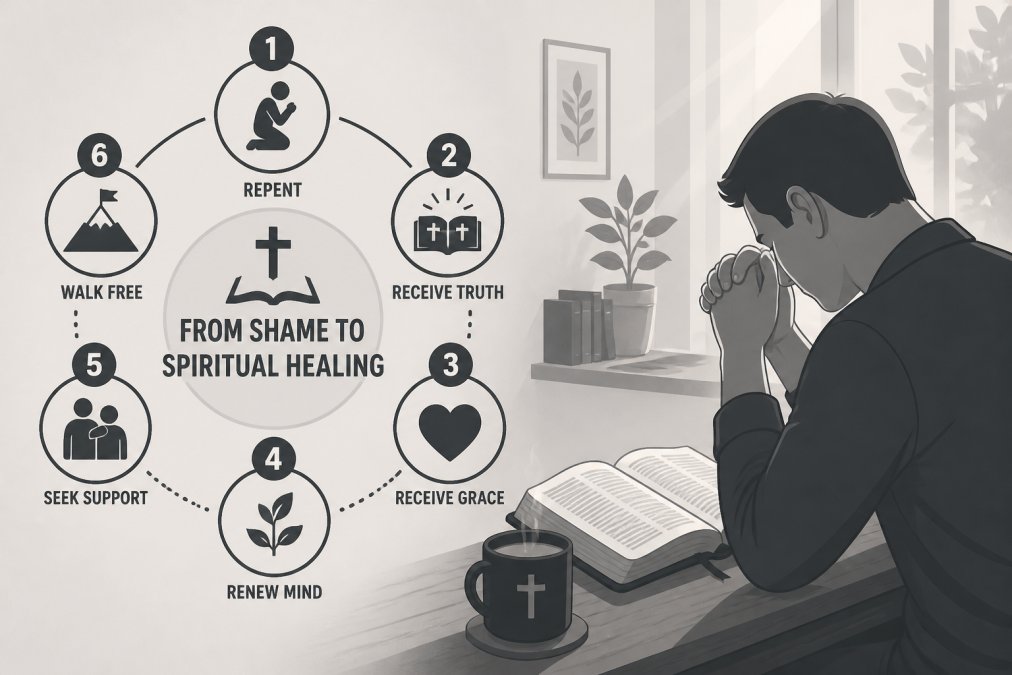
Step 4: Make amends where possible. If your shame involves hurting someone, consider reaching out: “I hurt you. I was wrong. I’m sorry.” Sometimes people won’t respond as you hope, but you’ve done what’s in your power.
Step 5: Practice receiving forgiveness daily. Each morning, remind yourself: “My sins are forgiven through Christ. I am not condemned. I am loved.” Repeat it even when you don’t feel it. Your feelings will eventually follow your faith.
Step 6: Build community. Shame thrives in isolation. Find people in a small group, church community, or with a spiritual director who know your story and love you anyway. Their consistent presence gradually rewires your response to shame.
Step 7: Consider professional support if needed. Some shame runs deep, sometimes rooted in trauma. There’s no shame in seeking help from a Christian counselor. God works through professional expertise too.
Conclusion: Living in Freedom and Divine Favor
The journey from shame to healing is real and possible. Scripture acknowledges shame’s weight fully but declares with absolute certainty that shame is not your final identity.
You are not defined by your worst moment or others’ rejection. You are defined by Christ’s redemption. You are loved with a love that doesn’t fluctuate based on your performance. You are honored not because you’ve earned it but because Christ bore your shame and rose to give you His honor.
This transformation happens as you encounter God’s grace repeatedly through prayer, Scripture, community, and time. It happens as you practice receiving forgiveness and allow others to reflect God’s love back to you.
The brokenhearted are invited to healing. The ashamed are invited to honor. The condemned are invited to freedom. This is the heart of the Gospel.
Encourage Further Bible Study
This guide from BibleTopSearch.com is just the beginning of your exploration. We encourage you to:
- Read the Scripture passages mentioned above slowly and prayerfully. Let them speak to your specific situation.
- Watch our corresponding YouTube video on understanding shame and grace for deeper teaching and real-life examples.
- Download the free BibleTopSearch Bible guide on redemption and identity in Christ. It includes daily Scripture readings, reflection questions, and prayer prompts designed to help you internalize these truths.
- Continue exploring Bible Answers on related topics like forgiveness, identity in Christ, and God’s love. Each article builds on these foundational truths.
- Consider joining a Bible study group in your church or community. Studying Scripture with others provides accountability, encouragement, and the opportunity to see how God’s Word applies across different life situations.
Your shame doesn’t have the final word. Christ does. And His word over you is: beloved, forgiven, honored, free.
Frequently Asked Questions
What is the biblical difference between guilt and shame?
Guilt is the feeling that you’ve done something wrong; shame is the belief that you are fundamentally wrong. The Bible addresses both. Guilt can lead to repentance and reconciliation with God (2 Corinthians 7:10), but shame often isolates us and contradicts our identity in Christ. Jesus paid for our guilt through atonement, and His grace transforms our shame into honor and righteousness.
How does the Bible say we can overcome shame?
Scripture teaches that confession, repentance, and receiving God’s forgiveness are central to overcoming shame. First John 1:9 promises cleansing when we confess our sins. Prayer invites God’s presence into our pain, and meditating on promises like Romans 8:1 (no condemnation for those in Christ) rewires our identity. Spiritual healing comes through community, Scripture study, and trusting in Christ’s redemption.
Are there Bible verses that address feelings of unworthiness?
Yes. Psalm 34:5 promises that those who look to God are radiant with joy. Ephesians 1:3-7 reminds us we are blessed and redeemed in Christ. Isaiah 54:4 directly addresses shame, promising that you will forget the shame of your youth. Zephaniah 3:17 reveals God’s delight in you. These verses counter the lie of unworthiness with the truth of your value in Christ’s eyes.
How did Jesus respond to people experiencing shame?
Jesus consistently showed compassion to the shamed. He spoke kindly to the woman caught in adultery (John 8:10-11), healed the demon-possessed man whom others rejected (Mark 5:1-20), and ate with tax collectors society scorned (Matthew 9:10-13). His response was never condemnation but invitation to transformation. He looked past their shame to their potential for redemption and restoration.