
Table of Contents
- Short Answer: Trusting God’s Plan Begins with One Step
- Biblical Context: What Scripture Says About God’s Plan
- Step 1: Seek Truth Through Scriptures on God’s Will
- Step 2: How to Overcome Spiritual Doubt and Unbelief
- Step 3: Build a Life of Prayers for Trusting God
- Step 4: Surrender Control and Embrace Divine Timing
- Step 5: Recognize God’s Guidance in Daily Life
- Step 6: Find Peace in Uncertainty Through Community
- Common Misunderstandings About Trusting God’s Plan
- Practical Application for Today
- Frequently Asked Questions
Last Updated: September 16, 2026
Short Answer: Trusting God’s Plan Begins with One Step
Learning how to trust God‘s plan step by step starts with a single honest prayer: “Lord, I don’t understand, but I’m willing.” Trust grows through Scripture, prayer, surrender, and community, not through certainty about the future. Trust is not a feeling you wait for. It is a decision you practice, one step at a time, until it becomes the way you live.
Proverbs 3:5-6 sets the foundation: “Trust in the Lord with all your heart, and do not rely on your own insight. In all your ways acknowledge him, and he will make straight your paths” (NRSVCE).
That verse is not a promise of easy answers. It is an invitation into a relationship.
Below, we’ll walk through six practical steps, the Scriptures that anchor each one, and the misunderstandings that trip people up along the way. If you have ever prayed “God, what are you doing?” and heard silence, this guide is for you.
Biblical Context: What Scripture Says About God’s Plan
God’s plan is His loving purpose for creation and for each person, worked out through providence rather than through a detailed script handed to us in advance. Scripture speaks of God’s will in two ways: His revealed will (what He commands, like loving your neighbor) and His hidden will (the specific path your life will take).
Divine providence is the guidance by which God leads His creation toward perfection. That means your circumstances are not random. They are held.
Jeremiah 29:11 is often quoted here: “For surely I know the plans I have for you, says the Lord, plans for your welfare and not for harm, to give you a future with hope” (NRSVCE). Read the surrounding verses, though. Israel heard that promise while in exile, decades from returning home. The plan was real. The timeline was not what they wanted.
That tension is where most of us live.
Step 1: Seek Truth Through Scriptures on God’s Will
The first step in trusting God’s plan is filling your mind with what God has actually said. Feelings shift daily. Scripture does not.
Start with passages that speak directly to guidance and trust:
- Proverbs 3:5-6, trust over self-reliance
- Psalm 37:5, “Commit your way to the Lord; trust in him, and he will act” (NRSVCE)
- Jeremiah 29:11-13, plans, waiting, and seeking
- Romans 8:28, God working all things for good
- James 1:5, asking for wisdom without shame
Key Passages to Study This Week
Read one passage each day, slowly. Write down one sentence about what it says about God’s character, and one sentence about your current situation. That simple practice builds biblical wisdom faster than reading ten chapters in a rush.
A common mistake is reading Scripture only when you’re in crisis. Readers who build a daily habit before the hard season arrives find that trust comes more naturally when it’s tested. Fifteen minutes a day beats three hours once a month.
Step 2: How to Overcome Spiritual Doubt and Unbelief
Doubt is not the opposite of faith. Unbelief refuses to bring questions to God; doubt brings them honestly and stays in the conversation. Most articles stop there. But if you have ever lain awake at 2 a.m. rehearsing the same anxious thought, you know that “stay in the conversation” is easier said than done. There is a psychological layer to doubt that spiritual advice alone does not always reach.
Two Kinds of Doubt (and Why the Difference Matters)
Before you can overcome spiritual doubt, you need to know which kind you are facing, because they need different responses.
Intellectual doubt asks questions like “Is this true?” It is about evidence, coherence, and meaning. It responds to study, reading, and patient conversation with people who have thought deeply about the faith.
Emotional doubt asks questions like “Is this safe?” It is about exhaustion, grief, burnout, and fear. It does not respond to more information. It responds to rest, lament, and presence.
A common pattern is that people treat emotional doubt with intellectual answers. They read five apologetics books while running on four hours of sleep and wonder why nothing lands. If you are exhausted, the honest first step may be sleep, a meal, and a phone call, not another argument.
The Anxiety Loop That Feeds Doubt
Anxiety and doubt often travel together. Anxiety narrows attention onto the worst possible outcome, and the mind mistakes that vividness for likelihood. A single unanswered prayer becomes evidence that God is absent. A closed door becomes proof that you misheard Him.
Naming the loop breaks some of its power. When you notice yourself rehearsing the same fear for the tenth time, try saying: “This is anxiety talking, not the Holy Spirit, and not the facts.” That is not denial. It is discernment.
Three Practices That Actually Help
- Name it out loud to one person. Not a vague post, not a journal entry nobody reads. One trusted believer, this week. Jesus met a father in Mark 9:24 who cried, “I believe; help my unbelief!” (NRSVCE). That prayer was answered, but it was prayed in the presence of Christ, not in isolation.
- Separate the question from the hour. Write your hardest question on paper. Then ask: is this a question for 2 a.m., or a question for daylight, with coffee, and a Bible open? Most questions feel unanswerable at night and workable in the morning.
- Keep one small obedience. When everything feels uncertain, do the next small thing you know is right: show up to Mass or church, text the friend, read the one psalm. Faithfulness in small things rebuilds confidence faster than waiting for a big emotional breakthrough.
Isolating yourself during doubt is the single most common mistake we see. Silence feeds unbelief, and the longer you stay away from prayer and fellowship, the harder it becomes to return. Tell one trusted person this week, not because you have it together, but precisely because you do not.
If anxiety or depression is making it hard to function day to day, that is not a spiritual failure. Talking with a doctor or a licensed counselor is a wise and faithful step, not a substitute for prayer.
What Doubt Is Not
Doubt is not the same as sin. It is not the same as walking away. Thomas doubted and was still called to be an apostle. Honest doubt, brought to God, becomes a doorway rather than a wall. The goal is not to feel certain. The goal is to keep showing up.
Step 3: Build a Life of Prayers for Trusting God
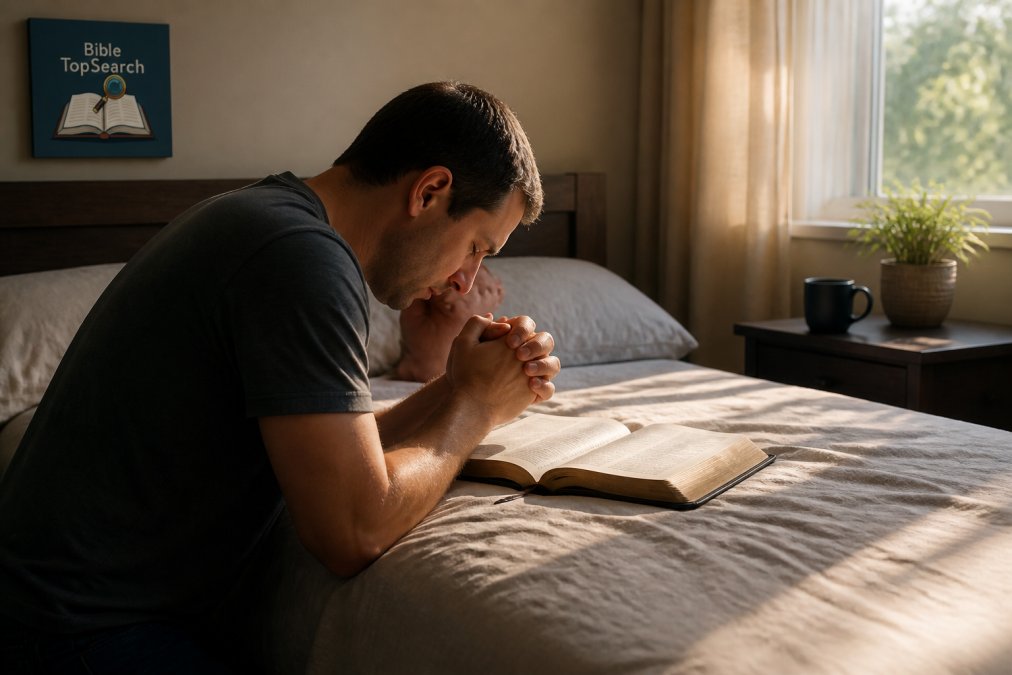
Prayer is where trust moves from theory to practice. You cannot surrender to someone you never speak with.
Prayers for trusting God do not need to be eloquent. They need to be honest. The Psalms give you language when you have none: “To you, O Lord, I lift up my soul. O my God, in you I trust” (Psalm 25:1-2, NRSVCE).
Build a rhythm rather than relying on inspiration:
- Morning: offer the day before you check your phone
- Midday: a short breath prayer, “Jesus, I trust in you”
- Evening: review the day and thank God for one specific thing
A Simple Daily Prayer You Can Start Today
Lord, I don’t see the whole picture, but I trust the One who does. Take my plans, my fears, and my timeline. Give me the grace to do the next right thing today, and the peace to leave tomorrow in your hands. Amen.
Step 4: Surrender Control and Embrace Divine Timing
Surrendering control does not mean passivity. It means doing your part faithfully while releasing the outcome.
This is the hardest step for most people, and it is the one that changes everything. Divine timing rarely matches our calendars. Abraham waited twenty-five years for the son God promised. Hannah waited years for Samuel. Zechariah and Elizabeth waited into old age for John.
Notice what they did while waiting: they kept living, kept worshiping, kept serving. They did not sit still and stare at the sky.
A practical exercise: write down the outcome you are gripping most tightly. Then write one sentence beneath it: “This belongs to God, not to me.” Keep it somewhere you’ll see it.
Enjoyed this article? Download your FREE guide: Ten Difficult Bible Questions —Answered. →
Trust grows in the gap between what God has promised and what you can currently see. That gap is not a failure of faith. It is where faith is formed.
Step 5: Recognize God’s Guidance in Daily Life
God’s guidance usually arrives quietly. It rarely comes as a lightning bolt. But “look for peace and wise counsel” is where most articles stop, and it is where most readers get stuck, because in real life the signals conflict. Scripture is clear, your friend says wait, a door opens, and your gut says run. What then?
The Four Channels of Guidance
Scripture speaks of God guiding His people through several ordinary means. Look for guidance in four places:
- Scripture that speaks directly to your situation, read in context and not as a fortune cookie
- Wise counsel from mature believers who know you and have no stake in your decision
- Circumstances, doors that close and open, though circumstances alone can mislead
- Interior peace, the persistent calm Ignatius of Loyola described as a key marker of God’s movement in the soul
None of these is infallible on its own. The wisdom is in reading them together.
A Trust Audit: Weighing the Signals
Here is a concrete framework you can use for any decision. Score each channel from 1 (strongly against) to 5 (strongly for). Be honest, the point is not to get a high score, but to see where the signals disagree.
| Channel | What to Ask | Score (1-5) |
|---|---|---|
| Scripture | Does this contradict God’s clear commands, or is it consistent with them? | |
| Counsel | Have 2-3 mature believers, who know me, weighed in honestly? | |
| Circumstances | What doors have opened or closed, and over what timeframe? | |
| Peace | Does one option bring a lasting calm, even if it is harder? | |
| Fruit | What has this direction produced so far, patience, or anxiety? |
How to Read Your Scores
All five high (20-25): Move forward, but stay open. Even good decisions need ongoing discernment.
Mixed, with peace and Scripture high: This is the most common real-world pattern. Lean on the two channels that carry the most weight, Scripture first, then peace, and let counsel and circumstances confirm rather than decide.
Scripture low, everything else high: Stop. No amount of peace or open doors overrides clear Scripture. This is the one non-negotiable row in the table.
Peace low, everything else high: Wait. Persistent unrest is worth listening to. It may be fear, or it may be the Holy Spirit. Give it a week and ask a trusted friend to help you tell the difference.
A Word on Timing
Guidance is rarely a single moment. More often it is a direction confirmed over weeks. If you feel pressure to decide today, that pressure is usually not from God. Write your scores down, date them, and revisit in seven days. Patterns emerge that a single anxious night cannot show you.
God’s guidance is not a puzzle to solve but a relationship to walk in. The table is a tool, not a test. If you finish it and still feel unsure, that is not failure, it is an invitation to keep praying, keep asking, and keep trusting the One who already knows the way.
Step 6: Find Peace in Uncertainty Through Community
You were not meant to carry uncertainty alone. Spiritual community is not a nice extra; it is a means of grace.
Hebrews 10:24-25 tells us not to neglect meeting together, but to encourage one another. When your own faith is thin, you borrow from the faith of others. That is not weakness. That is how the body of Christ works.
Practical ways to build that support:
- Join a small group or Bible study that meets weekly
- Ask one trusted friend to check in on you during a hard season
- Serve someone else. Hospitality and service pull you out of your own head
- Receive the sacraments regularly
Peace in uncertainty is not the absence of questions. It is the presence of people who will sit with you while you ask them.
The thing nobody tells you about spiritual community is that it works both directions. The week you show up to encourage someone else is often the week your own doubt loosens its grip.
Common Misunderstandings About Trusting God’s Plan
Trusting God does not mean you will never feel afraid, and it does not mean you stop making plans. It means your plans sit under His, not the other way around.
Here are three misunderstandings we hear often:
“If I trust God, everything will work out the way I want.” Scripture never promises that. It promises His presence, His purposes, and a future with hope, not your preferred outcome on your preferred timeline.
“Trusting God means I stop trying.” Passivity is not faith. Nehemiah prayed and then posted guards. Faith and effort work together.
“Doubt disqualifies me.” Thomas doubted and was still called to be an apostle. Honest doubt, brought to God, becomes a doorway rather than a wall.
Practical Application for Today
Pick one step and start there. Not all six. One.
If you are new to reading the Bible seriously, begin with Step 1 and read one passage a day for a week. If you are already praying but still anxious, focus on Step 4 and physically write down what you are releasing. If you feel alone in this, Step 6 is your starting point, and it may be the most important one.
Set a reminder on your phone for tomorrow morning. Open your Bible. Say the prayer. Do the next right thing.
That is how trust is built. Not in one dramatic moment, but in small, repeated acts of faithfulness over months and years.
Uncertainty is exhausting, and it is easy to feel like you are the only one struggling to trust God’s plan. You are not alone, and you do not need a theology degree to find clarity. BibleTopSearch.com offers free, biblically faithful answers to the questions people search most, with carefully selected Scripture, plain-language explanations, and links to in-depth video teachings you can return to anytime. Download your free guide now, watch the related video teaching, and keep exploring Bible Answers as you grow in trust, one step at a time.
Frequently Asked Questions
What scripture encourages us to trust in God’s plan?
Proverbs 3:5-6 anchors this: ‘Trust in the Lord with all your heart, and do not rely on your own insight. In all your ways acknowledge him, and he will make straight your paths’ (NRSVCE). Jeremiah 29:11 also reminds believers that God’s intentions are for welfare and hope, not harm. Reading these passages slowly, perhaps one verse a day, helps them move from head knowledge to heartfelt trust over time.
How can I fully surrender my life to God’s plan?
Surrender is not a single decision but a daily practice. Start each morning by naming one area you are gripping tightly, then pray words like Jesus prayed in Gethsemane: ‘Not what I want, but what you want’ (Mark 14:36, NRSVCE). Over weeks, this small act of releasing control reshapes how you respond to uncertainty and aligns your desires with God’s will.
How do I distinguish between my own desires and God’s plan?
Discernment grows through prayer, Scripture, and wise counsel. Ask whether a desire aligns with biblical principles, whether it brings lasting peace, and whether trusted believers confirm it. Acts 15 shows the early church testing decisions in community. If a choice consistently contradicts Scripture or produces only anxiety, it likely is not from God.
What does the Bible say about trusting God when things go wrong?
Romans 8:28 promises that ‘all things work together for good for those who love God’ (NRSVCE), not that all things are good. Joseph’s story in Genesis 50:20 shows God redeeming what others meant for harm. Trusting God’s plan does not deny pain; it holds onto hope that He is still working, even in seasons that feel like spiritual silence.