Table of Contents
- What Is Biblical Mindfulness?
- How Biblical Mindfulness Differs from Secular Mindfulness
- Step 1: Create a Sacred Space for Stillness
- Step 2: Begin with an Anchor Prayer
- Step 3: Practice Intentional Breathing and Scripture Meditation
- Christian Mindfulness Exercises for Daily Practice
- How to Practice Stillness in Prayer
- Troubleshooting Common Distractions in Biblical Mindfulness
- Bringing Biblical Mindfulness into Your Daily Life
- Conclusion and Encouragement
- Frequently Asked Questions
Last Updated: September 21, 2026
What Is Biblical Mindfulness?
Biblical mindfulness is the practice of bringing full awareness and intentional attention to God’s presence in the present moment, grounded in Scripture and prayer. It combines focused attention with spiritual surrender, helping you experience God’s peace and guidance in everyday life.
Unlike secular mindfulness, which emphasizes detachment from thought, biblical mindfulness invites you into deeper communion with Christ. You’re not emptying your mind, you’re filling it with God’s truth. This practice is a spiritual discipline that trains your attention on God’s voice, His Word, and His work in your life right now.
This practice isn’t new. Throughout Scripture, believers practiced forms of contemplative prayer and meditation on God’s Word. What’s changed is our ability to apply these ancient practices to modern stress and distraction.
How Biblical Mindfulness Differs from Secular Mindfulness
The core difference lies in intention and object of focus. Secular mindfulness aims for mental clarity through non-judgmental observation of thoughts. Biblical mindfulness aims for spiritual transformation through intentional connection with God.
Here’s what sets them apart:
- Focus: Secular mindfulness observes thoughts without judgment; biblical mindfulness directs attention toward God’s presence and truth
- Goal: Secular mindfulness reduces stress through detachment; biblical mindfulness brings peace through relationship with Christ
- Foundation: Secular mindfulness is built on psychology; biblical mindfulness is rooted in Scripture and faith
- Surrender: Secular mindfulness teaches acceptance; biblical mindfulness teaches surrender to God’s will
The apostle Paul wrote about this distinction in Philippians 4:6-7. He didn’t tell believers to observe their anxiety without judgment. He told them to bring their requests to God with thanksgiving, and “the peace of God, which surpasses all understanding, will guard your hearts and your minds in Christ Jesus” (NRSVCE).
This is the promise of biblical mindfulness, not just calm, but transformation through God’s presence.
Step 1: Create a Sacred Space for Stillness
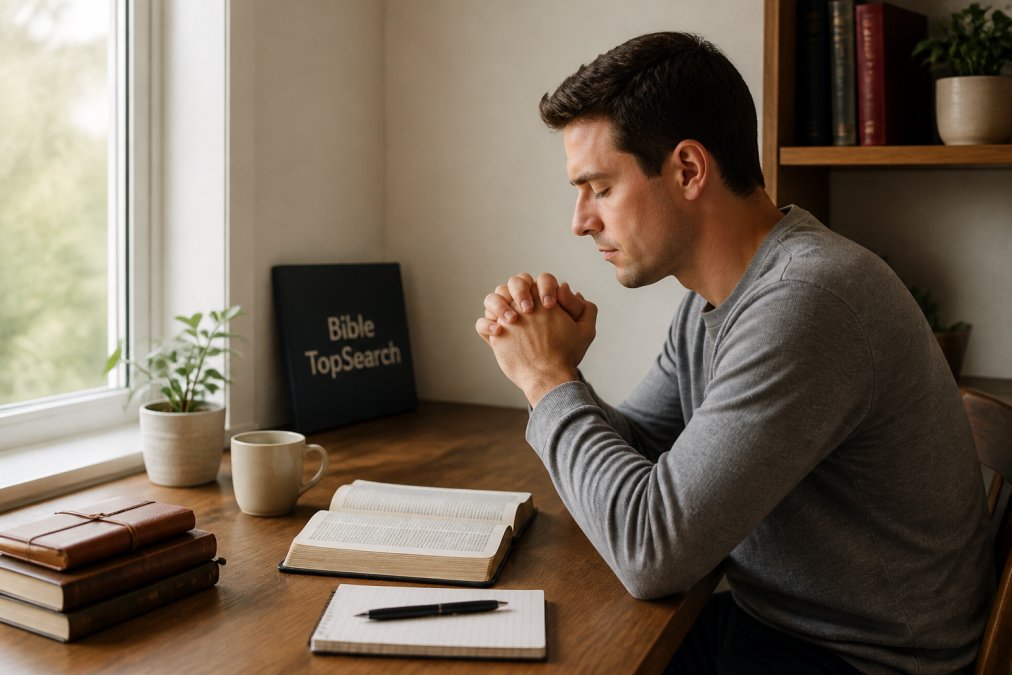
Before you practice biblical mindfulness, create a physical environment that supports your spiritual focus. This doesn’t require anything elaborate. You need a quiet place where distractions are minimal and you can be alone with God.
Choose a location where you can sit comfortably for 10-20 minutes without interruption. This might be a corner of your bedroom, a chair by a window, or a quiet spot in your home. Some people find a specific chair or cushion helps signal to their mind that this is prayer time.
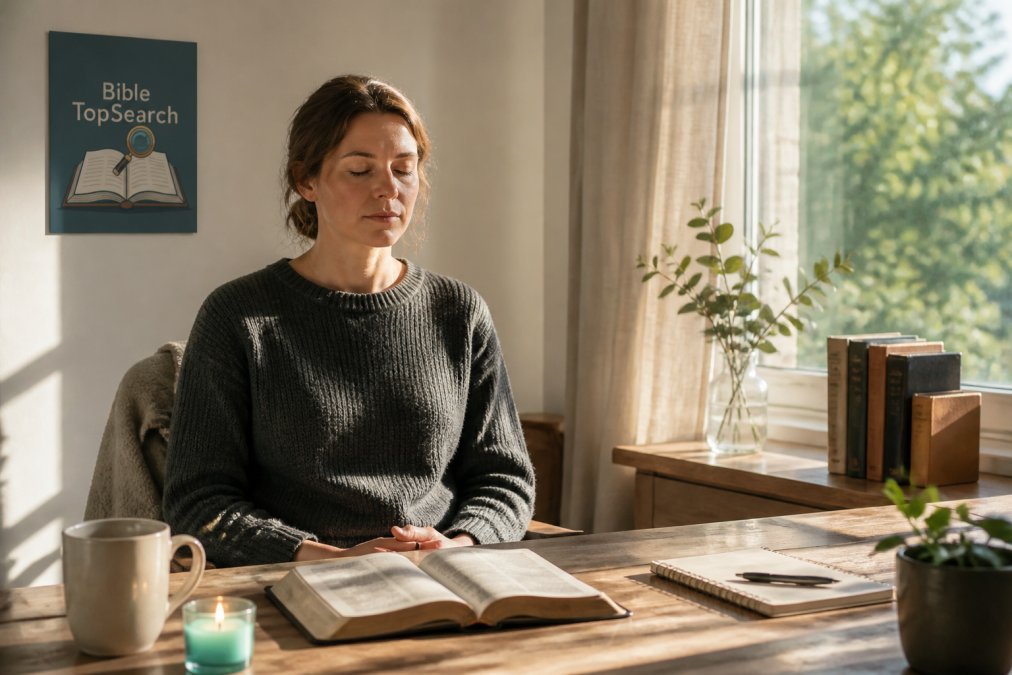
Prepare your space with intention:
- Remove your phone or place it in another room
- Close doors to reduce noise
- Dim harsh lighting or open curtains for natural light
- Have your Bible and a journal nearby if you plan to write
- Consider soft background elements like a candle, plant, or simple cross
The space itself becomes a physical reminder that you’re entering a time set apart for God. Consistency matters. Using the same location daily helps your mind recognize it as a place of prayer and presence.
Many people find that morning, before the day’s demands begin, is the best time for this practice. Your mind is fresher, and you’re less likely to be interrupted.
Step 2: Begin with an Anchor Prayer
An anchor prayer is a short, Scripture-based phrase that you return to whenever your mind wanders. It serves as your spiritual anchor in the present moment, just as a physical anchor holds a boat steady.
Choose a prayer that resonates with your current spiritual need. Here are examples:
- “Jesus, I surrender this moment to You”
- “Your peace, O God, is all I need”
- “I am present with You, Lord”
- “Speak, Lord; Your servant is listening” (based on 1 Samuel 3:9)
- “Not my will, but Yours be done” (based on Luke 22:42)
Your anchor prayer should be short enough to say in one breath and meaningful enough to center your heart on God. As you settle into your sacred space, speak or whisper your anchor prayer three times slowly. Let the words sink deeper with each repetition.
Throughout your practice, whenever you notice your mind has drifted to worries, plans, or distractions, gently return to your anchor prayer. This isn’t failure, it’s the practice itself. Your mind will wander. That’s normal. The spiritual discipline is in returning, again and again, to God’s presence.
Step 3: Practice Intentional Breathing and Scripture Meditation
Breathing connects your body and spirit. When you breathe intentionally, you signal to your nervous system that you’re safe. You also create a rhythm that supports focus.
Begin with slow, deep breathing. Inhale through your nose for a count of four. Hold for a count of four. Exhale through your mouth for a count of four. Do this five times. You should feel your body relax.
Now pair your breathing with your anchor prayer or a short Scripture passage. As you inhale, pray the first part. As you exhale, pray the second part.
Example using Psalm 46:10 (NRSVCE):
- Inhale: “Be still”
- Exhale: “and know that I am God”
Or with Philippians 4:7 (NRSVCE):
- Inhale: “The peace of God”
- Exhale: “guards my heart and mind”
Continue this breath-prayer for 5-10 minutes. Don’t rush. The goal isn’t to think about the verse deeply, it’s to let the words settle into your spirit through the rhythm of breathing.
The combination of breath, movement, and Scripture creates a sensory anchor that keeps your mind present with God instead of lost in worry or distraction.
Christian Mindfulness Exercises for Daily Practice
These exercises help you develop the habit of biblical mindfulness. Start with one and practice it for a week before adding another.
Lectio Divina (Divine Reading)
This ancient practice involves four steps:
- Read (Lectio): Choose a short Scripture passage. Read it slowly, aloud if possible. Notice which words or phrases stand out to you.
- Meditate (Meditatio): Repeat the phrase that caught your attention. Sit with it. What is God saying to you through these words?
- Respond (Oratio): Pray your response to God. Ask Him questions. Tell Him what you’re feeling. Be honest.
- Rest (Contemplatio): Sit in silence for a few minutes. Simply be present with God. No words needed.
Body Awareness Prayer
Slowly scan your body from head to toe, noticing any tension or tightness. As you notice each area, imagine God’s peace flowing through it. Speak to God about what you’re carrying in your body, stress, grief, joy, gratitude.
Scripture Memorization with Presence
Choose one verse. Write it on a card. Throughout the day, pause and recite it slowly three times. Each time, focus on a different word. What does that word mean? How does it apply to your life right now?
Gratitude Inventory
Sit quietly and name three things you’re grateful for today. For each one, pause and feel the gratitude in your body. Notice where you feel it, your chest, your heart, your breath. Let yourself fully experience thankfulness.
How to Practice Stillness in Prayer
Stillness is uncomfortable for many people. Our culture teaches constant doing. But the Bible repeatedly invites us into stillness as a spiritual practice. And modern neuroscience is beginning to show us why this ancient practice is so powerful for both body and soul.
The Biblical Foundation for Stillness
The psalmist wrote, “Be still, and know that I am God” (Psalm 46:10, NRSVCE). This isn’t passive emptiness. It’s active trust. You’re choosing to stop striving and to trust God’s presence and power.
Throughout Scripture, stillness appears as a prerequisite for encountering God. Moses stood still to witness God’s presence in the burning bush (Exodus 3:5). Jesus Himself withdrew to quiet places to pray (Luke 5:16). Stillness creates the conditions for listening.
What Happens in Your Brain During Prayer and Stillness
When you practice stillness in prayer, your nervous system undergoes measurable changes. As you slow your breathing and quiet your mind, your body shifts from a state of activation (the “fight or flight” response) into what’s called the parasympathetic state, often called “rest and digest.” This isn’t mystical; it’s physiology.
During this state, your heart rate lowers, your blood pressure decreases, and your cortisol levels (the stress hormone) begin to decline. At the same time, your brain’s default mode network, the part that generates self-referential thinking, worry, and rumination, becomes less active. This is why stillness feels peaceful. Your brain is literally shifting away from the patterns that generate anxiety.
But here’s what makes biblical stillness unique: you’re not just achieving a relaxed state through breathing techniques. You’re directing your attention toward God. This intentional focus on the divine, combined with the physiological calm, creates a state where you’re neurologically and spiritually open to God’s presence. Your mind settles not just because you’re breathing slowly, but because you’re resting in trust.
How to Begin Practicing Stillness
Start small. Commit to five minutes of silent prayer daily. Sit in your sacred space. Pray your anchor prayer. Then simply be present with God. Don’t try to think spiritual thoughts or have profound experiences. Just be there.
Your mind will offer you a stream of thoughts:
- Reminders about tasks you need to do
- Worries about the future
- Memories from the past
- Random observations
Don’t fight these thoughts. Acknowledge them gently and return to your anchor prayer or to simple presence with God. Think of your thoughts as clouds passing through the sky. You notice them, but you don’t grab them or follow them. You let them pass.
This isn’t failure; this is the practice itself. Neuroscientists studying meditation have found that the ability to notice when your mind has wandered and gently redirect it is actually the core skill being developed. Each time you return to your anchor, you’re strengthening the neural pathways associated with focus and intentional attention. Over time, the gaps between distracting thoughts lengthen. Your mind settles. This is where deep spiritual work happens, not in thinking, but in resting in God’s presence.
The Progression of Stillness Practice
Week 1-2: Practice five minutes daily. Your mind will be very active. This is normal. You’re training a new habit.
Week 3-4: Extend to seven or ten minutes. You may notice slightly longer periods of calm. Some days will feel harder than others.
Week 5+: Continue with ten to twenty minutes. By now, your nervous system recognizes this as a safe time. Your body may begin to relax more quickly. You might experience moments of genuine peace or a sense of God’s presence.
Remember: The goal isn’t to achieve a particular feeling or experience. The goal is presence. Some of your best prayer times may feel unremarkable in the moment but produce deep spiritual fruit over time.
If you struggle to sit still, try pairing stillness with gentle movement. Sit in silence for two minutes, then slowly walk while praying your anchor prayer for two minutes. Alternate between stillness and gentle motion. As your practice deepens, you’ll find it easier to remain still.
Troubleshooting Common Distractions in Biblical Mindfulness
Even experienced practitioners struggle with distractions. But some obstacles run deeper than a wandering mind. Here’s how to handle the most common challenges, from everyday interruptions to more serious spiritual barriers.
Physical Restlessness
Your body feels uncomfortable. You want to move. Solution: Adjust your posture before you begin. Use a cushion for support. Take three deep breaths and consciously relax each muscle group. If restlessness persists, it’s okay to gently stretch or shift position. The goal is presence with God, not physical perfection.
Racing Thoughts
Your mind jumps from thought to thought. You can’t focus. Solution: This often means you need to process something. Keep a journal nearby. When a persistent thought arises, jot it down quickly, “Call dentist,” “Email Sarah,” “Grocery list.” This tells your brain you’ve acknowledged it and will handle it later. Then return to your practice.
Emotional Waves
Sadness, anger, or anxiety surfaces unexpectedly. Solution: This is normal and healthy. Your practice is creating space for emotions to emerge. Welcome them. Cry if you need to. Pray about what you’re feeling. God meets you in your emotions. Don’t push them away.
Falling Asleep
You drift off during prayer. Solution: This might mean you need more sleep. Prioritize rest. If you’re well-rested and still struggling, try practicing at a different time of day or in a position that’s slightly less comfortable. Standing or kneeling can help you stay alert.
Feeling Like You’re “Doing It Wrong”
You compare your experience to others or feel like nothing is happening. Solution: There’s no single “right” way to practice biblical mindfulness. Your experience is valid. Some days will feel peaceful. Other days will feel frustrating. Both are part of the practice. Trust the process.
Practicing in a Noisy or Chaotic Environment
Not everyone has a quiet home. If you’re a parent, caregiver, or live in a shared space, silence may be impossible. Solution: Biblical mindfulness doesn’t require silence; it requires intention. You can practice in a busy household. Use noise-canceling headphones with soft instrumental music or nature sounds. Practice during small windows: while waiting in the car, during a lunch break, or even in a bathroom for five minutes. Some practitioners find that practicing with background noise actually strengthens their ability to maintain focus on God’s presence despite distractions. Start with shorter sessions (three to five minutes) in noisy environments. As your practice deepens, you’ll find that external noise matters less because your internal focus on God becomes stronger.
Silence Triggering Anxiety or Trauma Responses
For some people, especially those with a history of trauma, silence and stillness can feel unsafe. Quiet spaces might amplify intrusive thoughts, panic, or dissociation. Solution: This is valid, and biblical mindfulness can still be practiced safely. Begin with guided practices rather than silent ones. Listen to a recorded Scripture passage, a guided prayer, or a Christian meditation app while practicing your breathing. The voice provides an anchor and prevents silence from becoming overwhelming. You might also practice biblical mindfulness in motion: walking slowly through nature while reciting Scripture, or doing gentle stretching while praying. Some trauma-informed practitioners recommend practicing with a trusted person nearby, or even practicing together. There’s no rule that says mindfulness must be silent. God meets you in whatever form of presence feels safe. If you’re working through trauma, consider speaking with a spiritual director or Christian counselor.
A common mistake is expecting biblical mindfulness to eliminate all stress or struggle. This practice doesn’t promise a problem-free life. It promises God’s presence and peace within your circumstances, even difficult ones. That’s the biblical promise: “Peace I leave with you; my peace I give to you” (John 14:27, NRSVCE). If you’re experiencing severe anxiety, depression, or trauma symptoms, mindfulness is a spiritual tool, not a replacement for professional mental health care. Seek both.
Bringing Biblical Mindfulness into Your Daily Life
The goal isn’t to meditate once a day and then live the rest of your day on autopilot. Biblical mindfulness is a way of living, a continuous awareness of God’s presence.
Here are practical ways to extend this practice throughout your day:
Pause Before Transitions
Before you move from one activity to another, leaving home, starting work, sitting down to eat, pause for three conscious breaths. Recite your anchor prayer. This keeps you tethered to God’s presence instead of running on autopilot.
Practice Presence with Others
When you’re with family, friends, or colleagues, practice full attention. Listen without planning your response. Make eye contact. Notice their words, tone, and body language. This is a form of biblical mindfulness applied to relationships. Jesus modeled this kind of attentive presence.
Notice God’s Creation
As you move through your day, pause to notice details: the color of the sky, the texture of tree bark, the taste of your coffee. Each moment is an opportunity to recognize God’s handiwork and presence.
Respond to Stress with Scripture
When anxiety or frustration arises, pause and recite a verse that speaks to your situation. Psalm 23 for fear. Philippians 4:6-7 for anxiety. Romans 8:28 for confusion. Let Scripture reshape your thoughts in real time.
Practice Gratitude Before Bed
Before sleep, spend five minutes recounting moments from your day when you noticed God’s presence or provision. Write them down. This trains your mind to recognize God’s activity throughout your life.
Conclusion and Encouragement
Biblical mindfulness is a spiritual discipline that reconnects you with God’s presence in the midst of a busy, distracted world. It’s not complicated. It’s not reserved for monks or theologians. It’s available to anyone willing to create space, be still, and listen.
Start today. Choose one small practice, an anchor prayer, five minutes of stillness, a Scripture passage to breathe with. Do it tomorrow morning. Notice what happens. You might feel peace. You might feel nothing at all. Either way, you’re training your spirit to recognize and respond to God’s presence.
The Bible promises that when you seek God with your whole heart, you will find Him (Jeremiah 29:13). Biblical mindfulness is one way to do that seeking. It’s one way to practice the presence of Christ in your daily life.
Frequently Asked Questions
What is the difference between biblical mindfulness and secular mindfulness?
Biblical mindfulness centers on God’s presence and Scripture, inviting the Holy Spirit into your awareness. Secular mindfulness focuses on non-judgmental observation of thoughts without a faith foundation. The Christian approach anchors your attention on God’s truth, His peace, and His word, transforming how you respond to stress and anxiety through a relationship with Christ rather than through technique alone.
Can I practice biblical mindfulness if I’m new to Christianity?
Absolutely. Biblical mindfulness is accessible to everyone, whether you’re a lifelong Christian or just beginning your faith journey. Start with simple anchor prayers like ‘Jesus, I trust You’ and short Scripture passages. You don’t need theological training, just openness to God’s presence and willingness to sit quietly with Him. Many new believers find this practice helps them feel closer to Christ and more grounded in their faith.
How does biblical mindfulness help with spiritual doubt?
When you practice biblical mindfulness, you create space to encounter God’s presence directly rather than remaining stuck in anxious thoughts. By meditating on Scripture and practicing stillness, you allow the Holy Spirit to speak truth into your doubts. This present-moment awareness of God’s faithfulness, not just intellectual belief, can calm fear and rebuild confidence in your relationship with Him during seasons of questioning.
What should I do if I get distracted during biblical mindfulness practice?
Distraction is normal and not failure. When your mind wanders, gently return to your anchor prayer or Scripture without judgment. Treat distracting thoughts with compassion, acknowledge them and let them pass like clouds. Some people find it helpful to write down persistent thoughts beforehand to ‘release’ them. The practice isn’t about achieving perfect silence; it’s about repeatedly returning your heart to God’s presence with intention and grace.
Explore more on biblical mindfulness and spiritual growth at BibleTopSearch.com. Watch our in-depth video teaching on contemplative prayer, download your free Bible guide to Scripture meditation, and continue discovering answers to your most important faith questions. Return anytime you need clarity, encouragement, or a deeper understanding of what the Bible actually says about living in God’s presence.