
Table of Contents
- Short Answer: Does God Really Love Me?
- The Biblical Context of God’s Love
- Bible Verses About God’s Love That Anchor the Soul
- Common Misunderstandings About Feeling God’s Love
- Psychological Barriers to Receiving God’s Love
- The Catholic Perspective on God’s Love and Grace
- Overcoming Doubt in Faith: Practical Steps That Work
- Prayers for Feeling God’s Love When You Are Struggling
- How Understanding God’s Love Transforms Daily Life
- Conclusion and Encouragement to Keep Exploring
Last Updated: August 7, 2026
Short Answer: Does God Really Love Me?
Yes. According to Scripture, God’s love for you is unconditional, sacrificial, and unshakable, not based on your performance, your past, or your feelings on any given day. This guide from BibleTopSearch.com walks through what the Bible actually says about that love, why so many of us struggle to feel it, and how to move from knowing it in your head to experiencing it in your heart.
The Biblical Context of God’s Love
Scripture describes God’s love as an active, covenant commitment, a choice God made before the world began, renewed through every generation, and sealed in the person of Jesus Christ.
The Greek word used most often in the New Testament for this kind of love is agape. Unlike the love between friends or romantic partners, agape is defined by its orientation toward the highest good of the beloved, regardless of what is returned. It is not earned. It is given.
What 1 John 4:8 Reveals About Divine Nature
The clearest definitional statement in all of Scripture comes in a single, remarkable line: “Whoever does not love does not know God, for God is love” (1 John 4:8, NRSVCE). This verse does not say God has love, or that God shows love. It says God is love.
God’s love is not an attribute He switches on and off. It is His very nature. You are not waiting for God to decide to love you. You are standing before a being whose essential nature is love itself.
How God’s Love Differs From Human Love
Human love is conditional in ways we rarely admit. We love people more when they are kind to us, when they meet our needs, when they behave in ways we approve of.
Divine love operates on a completely different foundation. Romans 5:8 (NRSVCE) puts it plainly: “But God proves his love for us in that while we still were sinners Christ died for us.” God’s love moved toward humanity at its worst, not its best. Human love responds to goodness. Divine love creates goodness in the beloved.
This distinction matters enormously for people who feel unworthy. If God’s love were like human love, unworthiness would be a real barrier. Because it is not, unworthiness becomes irrelevant to whether the love exists.
Bible Verses About God’s Love That Anchor the Soul
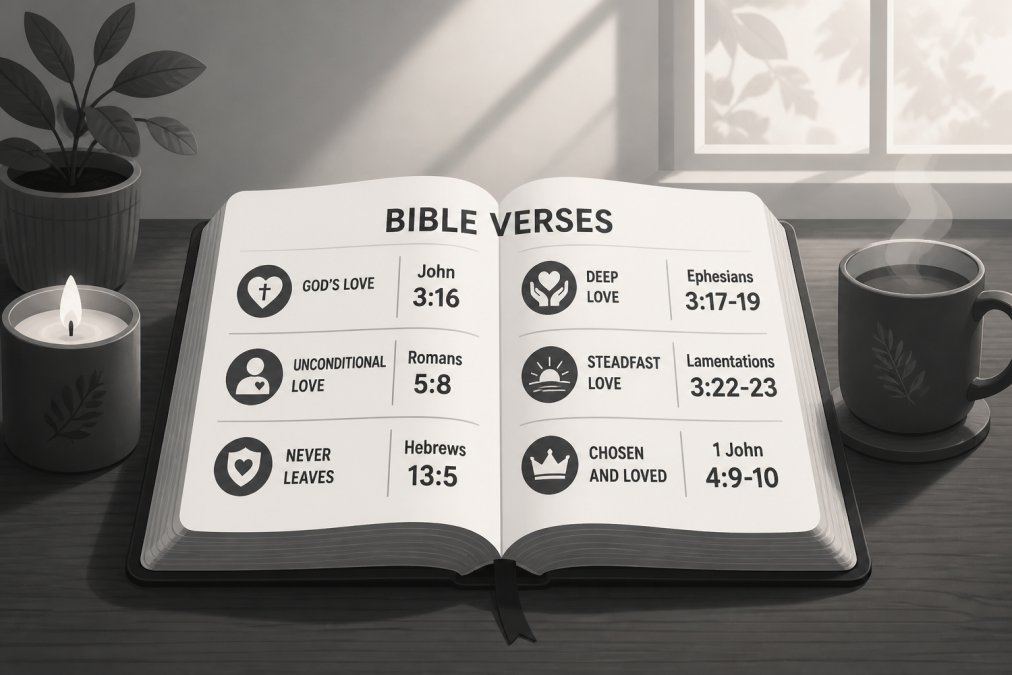
Scripture is filled with passages that speak directly to the question of God’s love. These are not abstract theological statements. They are anchors, words meant to hold you steady when feelings say otherwise.
(/bible-verses-for-dealing-with-stress/) About God’s Love That Anchor the Soul]
Here are several passages worth reading slowly, more than once:
- John 3:16 (NRSVCE): “For God so loved the world that he gave his only Son, so that everyone who believes in him may not perish but may have eternal life.” This is the scope of divine love, the entire world, including you.
- Jeremiah 31:3 (NRSVCE): “I have loved you with an everlasting love; therefore I have continued my faithfulness to you.” The word everlasting means this love has no expiration date.
- Romans 8:38-39 (NRSVCE): “For I am convinced that neither death, nor life, nor angels, nor rulers, nor things present, nor things to come, nor powers, nor height, nor depth, nor anything else in all creation, will be able to separate us from the love of God in Christ Jesus our Lord.” Paul closes every escape hatch for doubt.
- Zephaniah 3:17 (NRSVCE): “The Lord, your God, is in your midst, a warrior who gives victory; he will rejoice over you with gladness, he will renew you in his love; he will exult over you with loud singing.” God does not merely tolerate you. He sings over you.
- Psalm 139:13-14 (NRSVCE): “For it was you who formed my inward parts; you knit me together in my mother’s womb. I praise you, for I am fearfully and wonderfully made.” Your existence is not an accident. It is an act of love.
Read these passages out loud if you can. There is something about hearing scriptural truth spoken that reaches places silent reading does not.
These Bible verses about God’s love are not meant to be memorized as doctrine. They are meant to be prayed, sat with, and returned to, especially on the days when God feels distant.
Common Misunderstandings About Feeling God’s Love
Many people know all the right verses but still feel nothing. That is not a failure of faith. It is a gap between intellectual knowledge and lived experience.
Truth vs. Feeling: Why Intellectual Assent Is Not Enough
Intellectual assent is agreeing that something is true. Experiential faith is allowing that truth to reshape how you feel, how you live, and how you see yourself. These are not the same thing.
You can believe that God loves you the same way you believe that the Mariana Trench is the deepest point in the ocean, as a fact you have never personally experienced. Spiritual maturity involves moving from that kind of knowing into something more like abiding. Jesus used that exact word in John 15:9 (NRSVCE): “As the Father has loved me, so I have loved you; abide in my love.” Abiding is not passive agreement. It is active, intentional dwelling.
The gap between truth and feeling is usually a sign that something else is filling the space.
Why We Struggle to Believe We Are Loved
The struggle to believe in God’s love is rarely theological. Most people who cannot feel loved by God are not confused about doctrine. They are carrying wounds that make love feel unsafe or undeserved.
Common reasons people struggle to receive divine love include:
- A distorted image of God shaped by harsh or absent parenting
- Unresolved shame over past failures that feels too heavy to bring to God
- A performance-based faith that has unconsciously turned grace into a reward for striving
- Spiritual dryness, seasons where prayer feels empty and God feels silent
- Comparison, believing others are more worthy of love than you are
None of these are signs of bad faith. They are signs of being human. Scripture addresses every single one of them.
Psychological Barriers to Receiving God’s Love
Understanding God’s love involves more than reading the right verses. It requires examining the internal filters through which we receive love.
Attachment theory describes how early experiences with caregivers shape our capacity to trust love from any source, including God. Children who experienced love as conditional, unpredictable, or absent often grow into adults who unconsciously expect the same from God, regardless of what they intellectually believe.
Three specific psychological barriers are worth naming:
1. The unworthiness loop. Many believers feel that their ongoing sin disqualifies them from God’s love. They read Romans 5:8 and agree with it, but apply it to everyone except themselves. The fix is not to try harder to feel worthy. It is to recognize that worthiness was never the condition.
2. The performance trap. Some people were raised in faith environments where love was communicated through approval for right behavior. They carry that framework into their relationship with God, unconsciously believing that God’s love rises and falls with their spiritual performance. Galatians 3:3 (NRSVCE) speaks directly to this: “Are you so foolish? Having started with the Spirit, are you now ending with the flesh?”
3. The silence misreading. Periods of spiritual dryness are often misread as evidence that God has withdrawn His love. They are not. They are a normal part of the spiritual life, described by mystics and saints across centuries.
If you have experienced trauma, especially religious trauma, working through these barriers with a trained counselor or spiritual director can be genuinely important. Scripture and therapy often work together.
The Catholic Perspective on God’s Love and Grace
The Catholic tradition offers a particularly rich understanding of God’s love because it holds together two things that are sometimes separated: grace and participation. God’s love is entirely free and unearned, that is grace. And yet, we are invited to cooperate with it, to open ourselves to it, to let it transform us from the inside out.
The Catechism of the Catholic Church describes grace as “favor, the free and undeserved help that God gives us to respond to his call to become children of God.” Grace is not a transaction. It is an invitation into relationship.
The sacramental life of the Church, particularly the Eucharist and Reconciliation, is understood as a primary channel through which God’s love becomes tangible and experiential, not merely intellectual. For Catholics and those exploring the Catholic faith, the sacrament of Reconciliation is specifically designed as an encounter with divine mercy and love. Walking into a confessional is an act of believing that God’s love is stronger than your failure.
Overcoming Doubt in Faith: Practical Steps That Work
Overcoming doubt in faith is not about suppressing questions. It is about bringing them honestly to God and to Scripture, and then taking small, concrete steps that create space for experience to catch up with belief.
Here is a practical framework:
- Name the barrier. Write down the specific reason you struggle to feel loved by God. Is it shame? Is it silence? Is it a wound from the past?
- Bring it to Scripture. Find a verse that speaks directly to that barrier. Sit with it for a week.
- Pray it back to God. Take the verse and turn it into a prayer. “Lord, you say you love me with an everlasting love. I want to believe that. Help my unbelief.”
- Act as if it is true. Choose one action each day that reflects the belief that you are loved, serving someone, resting without guilt, accepting a kindness without deflecting it.
- Track small moments. Keep a brief journal of moments where you noticed something that felt like grace, beauty, or unexpected peace. Over time, these accumulate into evidence.
Interactive Reflection Exercises to Try This Week
Exercise 1: The Beloved Letter
Read Romans 8:38-39 slowly. Then write a short letter to yourself as if God were writing it, using the language of that passage. What would He say to you specifically about the things you are afraid disqualify you?
Exercise 2: The Gratitude Audit
List ten things in your life that you did not earn and cannot explain except as gift. This trains your attention to notice love that has already arrived.
Exercise 3: The Silence Sit
Spend ten minutes in complete quiet, not asking for anything. Simply be present. At the end, ask: “Was God here?” Most people find that the silence feels different after the question than before it.
The Role of Community in Experiencing God’s Love
Scripture is consistent on this point: we do not receive God’s love in isolation. The Church, the gathered community of believers, is described in 1 Corinthians 12 as the Body of Christ. When a member of that body loves you, something real and sacramental is happening.
Many people who cannot feel God’s love directly can feel it through a community that loves them faithfully. This is not a lesser experience. It is one of the primary ways God has chosen to make His love tangible in the world.
Finding a faith community that is warm, honest, and theologically grounded matters more than most people realize. If your current community does not help you feel more loved, that is worth paying attention to.
If you are not currently connected to a faith community, start small. Attend a single Mass or prayer group without any obligation to return. Notice whether you feel more or less alone afterward. That data matters.
Prayers for Feeling God’s Love When You Are Struggling
Prayer is not a technique for getting God to love you more. God’s love is already complete. Prayer is the practice of opening yourself to receive what is already there.

These short prayers are offered for the moments when you need words and do not have them:
When you feel unworthy:
“Lord, I know your Word says nothing can separate me from your love. I do not feel that right now. I am asking you to make it real to me. I bring you my shame and my failures. I believe, help my unbelief.”
When God feels silent:
“Father, I cannot hear you and I cannot feel you. But I choose to trust that you are here. Your Word says you will never leave me. I am standing on that promise, even when I cannot feel it.”
A prayer of surrender:
“Jesus, I have been trying to earn your love instead of receiving it. I let go of that striving now. I accept that I am loved, not because I deserve it, but because you are love. Let that truth settle into places in me that have never believed it.”
The Catholic tradition also offers rich formal prayers for this purpose, including the Anima Christi, the Act of Contrition, and the Litany of Trust.
How Understanding God’s Love Transforms Daily Life
The transformation that comes from truly receiving God’s love is not primarily emotional. It is practical. It changes how you treat yourself, how you treat others, and what you are fundamentally striving for.
People who have moved from intellectual belief to experiential faith tend to describe several consistent changes:
- Less striving, more resting. When you are no longer trying to earn love, you can stop performing and start living.
- Greater compassion for others. Receiving unconditional love makes it easier to extend it. 1 John 4:19 (NRSVCE) says: “We love because he first loved us.”
- Reduced fear. 1 John 4:18 (NRSVCE) says “perfect love casts out fear.” The deepest fear, that you are ultimately alone and unloved, loses its grip.
- A new basis for identity. When your identity is rooted in being loved by God rather than in your achievements, failures, or others’ opinions, you become more stable.
- Reconciliation becomes possible. When you have been forgiven much, forgiving others becomes less impossible.
| Shift | Before Receiving God’s Love | After Receiving God’s Love |
|---|---|---|
| Self-worth | Based on performance and approval | Rooted in identity as beloved child of God |
| Prayer | Transactional, asking for things | Relational, abiding and listening |
| Failure | Evidence of unworthiness | Occasion for grace and reconciliation |
| Relationships | Conditional, fear-driven | More generous, less defensive |
| Daily motivation | Striving to earn acceptance | Responding to love already given |
| Inner peace | Dependent on circumstances | Increasingly independent of circumstances |
Conclusion and Encouragement to Keep Exploring
Understanding God’s love for me is not a destination you arrive at once and then possess forever. It is a lifelong practice of returning to Scripture, to prayer, to community, and to the honest acknowledgment that some days you feel it and some days you do not. Both are part of the journey.
The Bible’s testimony is clear and consistent: God’s love is unconditional, sacrificial, and permanent. It is not waiting for you to become worthy. It has already moved toward you in Christ. Your part is not to earn it but to receive it, imperfectly, repeatedly, and with growing trust.
If you are in a season of doubt, shame, or spiritual dryness right now, you are not outside the reach of that love. You are exactly where many of the Psalms begin.
Continue exploring this topic with BibleTopSearch. Watch our corresponding YouTube video, download the free Bible guide on God’s love, and return to these passages as often as you need. Keep reading the Bible for yourself, and keep growing in your relationship with Christ. Your questions matter, and so does your journey toward believing that you are loved.
Frequently Asked Questions
How can I feel God’s love when I am struggling?
Start by returning to Scripture, especially Romans 8:38-39, which assures us that nothing can separate us from God’s love. Feeling follows truth, not the other way around. Honest prayer, even when it feels hollow, opens the door. Joining a faith community, practicing daily Scripture meditation, and speaking with a trusted pastor or spiritual director can also help you move from intellectual belief into an experiential sense of God’s unconditional presence and care.
What does the Bible say about God’s love for me?
The Bible describes God’s love as unconditional, sacrificial, and everlasting. John 3:16 tells us God gave his only Son out of love for the world. Romans 5:8 says Christ died for us while we were still sinners, before we earned anything. 1 John 4:8 states simply that God is love, making love part of his divine nature, not just a feeling he has toward us. These passages form the scriptural foundation for understanding that God’s love is not based on your performance or worthiness.
Why is it hard to accept God’s love?
Many people struggle to accept God’s love because of shame, past wounds, or a distorted view of self-worth rooted in early life experiences. If you grew up feeling unloved or were taught that love must be earned, receiving unconditional love can feel foreign or even suspicious. Psychological barriers like fear of vulnerability and deep-seated guilt can block what the mind already believes. Healing often involves both scriptural truth and intentional inner work, sometimes alongside a counselor or spiritual community.
How does God show His love to us today?
God shows his love through Scripture, through the sacraments in the Catholic tradition, through answered and unanswered prayer that shapes our character, and through the people he places in our lives. Creation itself reflects his blessing and care. Moments of unexpected peace, reconciliation after conflict, and the grace to keep going during hardship are all ways believers experience God’s active, unshakable commitment to their highest good. Staying attentive through daily spiritual practice makes these signs easier to recognize.
BibleTopSearch.com exists to help you find clear, biblically faithful answers to the questions that matter most, without needing a theology degree to understand them. Explore more Bible answers on our site, watch the corresponding video teaching on our YouTube channel, and download your free Bible guide to continue growing in your understanding of God’s Word. There is always more to discover, and you do not have to discover it alone.